ANGELICA: Two cars rolled up to the Angelica Sweet Shop just after 1 on Monday afternoon for one of Senator Kristen Gillibrand’s many stops across 10 of New York’s southern counties. With Gillibrand were her two small sons. Five year old Theo headed for the candy counter at the Sweet Shop while little Henry was content to peek around his grandmother’s neck. Gillibrand put her Senate office on wheels to move it from Chautauqua County eastward to her home in Columbia for what she calls “The Senate at your Super market” tour.
Several county dignitaries and an array of citizens from Wellsville, Andover, Alfred and certainly Angelica were on hand to greet the Senator offering her pamphlets and books to thumb through later hoping to build a concept of what Allegany County offers.
The visit started with Theo’s tour of the Sweet Shop candy wall where Gillibrand nabbed a quick Twizzler and then moved outside to take questions and define her position on a variety of topics. She is not holding town hall meetings but rather talking in small groups with constituents.
Health care is a huge concern. She’d like reforms to the health insurance industry that would end the practice of excluding people for pre-existing conditions. She supports preventive care and proposes that there be no co-pay for cancer screening tests. She also supports that there be a universal form to simplify office work and increase efficency.
Gillibrand supports a public option for which people would pay premiums of no more than 5% of their income. Along with that she would require a better reimbursement rate to the medical providers. In cities, the volume of patients helps the money flow into a service provider but in rural areas, the fee for service has to cover the cost of operating. There just aren’t enough people using the service to make up for low rates in rural areas.
Having said all that, she was doubtful that the legislative chambers would pass such an inclusive bill even though the end result would be lower costs for everyone. Right now insurance costs are increasing at four times the rate that salaries increase and it’s just not sustainable.
The average family income in Allegany County is $40,000 while basic insurance plans are $10,000. People can’t pay that. That makes people depend on the Emergency Room - the least efficient/ most expensive way to go.
Gillibrand is also looking at bringing alternative energy projects to the Southern Tier. She said we have the workforce, the education and the resources to get into cellulose ethanol, wind and solar power. There’s a history of manufacturing in this area and the country needs to make use of remaining expertise.
Gillibrand said that the anger over the cap and trade bill is really anger about the economy. In rural areas of New York the unemployment rate is 15%. She said that cap and trade allows clean industries to sell their carbon savings to dirtier industries that produce more carbon but said that what we really need is to clean up our air. In the Bronx, 25% of all children have asthma. The federal government might make money available to entrepreneurs to develop clean energy sources or to reduce air pollution and such small businesses could drive the economic engine.
“Our energy policy is part of the health debate when you look at air quality,” she said going on to voice concerns about obesity. The country spends $100 Billion a year on medical matters related to obesity and another $500 Billion on heart disease. She wants to ban trans-fats to encourage people to eat calories with more nutrition and to increase reimbursement rates for school lunches so schools can serve children actual chicken and not a frozen, processed item. She wants mandatory physical education for children for an hour a day in schools and she wants health insurance to cover dietary counseling for all.
At the end Gillibrand was asked to push for a public option while her party holds a majority in the senate. A robust, aggressive public option would drive prices down. She was also asked to make insurance companies subject to anti-trust laws. She said that the Senate just has to do something to help, to take a step forward and to start making changes.
Tuesday, August 18, 2009


Town Hall meeting
OLEAN, Sunday August 16
I went to the Eric Massa town hall meeting in Olean on Sunday night and then sent this Email to 6 people. On Monday, at the meeting with Senator Gillibrand I learned that my Email traveled to several other inboxes so I'm sending it to a few more.

It was exhausting.
In part it was bad because Eric let people go on and on. When I left I talked with some staffers to say that it might be better if he would give people 2 minutes to pose a question and let them come back a second time if there is time left. (A later Email from Eric said that he will continue to listen to every person's every word and try to understand them all.)
One guy wanted the government out of health care but he also wants the government to tell all insurance companies that they must become non profit. He doesn't want them to be not for profit because the profit motive is important but they should be non profit.
Another man said that money for women's health matters means for abortions because women are fornicators and abortions are the only women's health issue that there is. He wasn't the worst one but he said he was a retired doctor and that he knew what women are really like.
People railed against the left's plan to turn us into a socialist nation. Eric said that under socialism patients have no right to choose their doctor, doctors don't get to choose hospitals and there's someone else dictating what procedures would be allowed. That, he said, is what veterans face. Eric is on the veteran's insurance plan and refused to take the golden plan offered to all congressional members. He won't take it until all his constituents are covered by insurance. He also introduced an amendment that was accepted into the bill that would require congressmen and senators to be on the insurance plan created by whatever bill is passed.
I think that most of them were angry that they lost the election. I think the angry people at this meeting get their information from one or two right wing voices who enjoy manipulating people.

They would say that page such and such of the bill said this and that and Eric would turn to the page and read it to them and they would say he was lying. There were claims that the bill allows for the government to have full access to everyone's checking account when it actually says that it allows for e payments. Is that full access? They said that if the provision for an end of life directive wasn't about requiring death panels then it wouldn't have been rescinded.
Eric was patient and polite. He several times pointed out inconsistencies in the questions and demands put by an individual such as the person with the non profit/not for profit business but was repeatedly told that he was lying. He'd offer them the pages and insist he read the words on that page and they'd say, "Liar."
'there was yelling and booing. People would say they read the real bill on the internet.
He'd say that he really couldn't help them more than that and that he had to move on but I wished he'd said that more often.
I felt that the hall had about 1/3 mean spirited, nasty, loud people and 2/3 people interested in discussion. One man said that he knew he was speaking for 90% of the people in the hall and another woman said that he had no right to claim to know her feelings which differed sharply. That woman was great. Lisa someone.
One woman said she was being laid off and losing her health care but that she didn't want a public option,she wanted a job with health care. A public option wouldn't help her at all.
The air was full of anger and hatred. It was truly an awful place to be.
I was there with a supportive friend or I'd have sat in the car and sobbed afterward. We stayed for 3 hours. The meeting went on for 4 1/2 hours. The selfishness of the people speaking at the meeting who have insurance was astounding.
I went to the Eric Massa town hall meeting in Olean on Sunday night and then sent this Email to 6 people. On Monday, at the meeting with Senator Gillibrand I learned that my Email traveled to several other inboxes so I'm sending it to a few more.

It was exhausting.
In part it was bad because Eric let people go on and on. When I left I talked with some staffers to say that it might be better if he would give people 2 minutes to pose a question and let them come back a second time if there is time left. (A later Email from Eric said that he will continue to listen to every person's every word and try to understand them all.)
One guy wanted the government out of health care but he also wants the government to tell all insurance companies that they must become non profit. He doesn't want them to be not for profit because the profit motive is important but they should be non profit.
Another man said that money for women's health matters means for abortions because women are fornicators and abortions are the only women's health issue that there is. He wasn't the worst one but he said he was a retired doctor and that he knew what women are really like.
People railed against the left's plan to turn us into a socialist nation. Eric said that under socialism patients have no right to choose their doctor, doctors don't get to choose hospitals and there's someone else dictating what procedures would be allowed. That, he said, is what veterans face. Eric is on the veteran's insurance plan and refused to take the golden plan offered to all congressional members. He won't take it until all his constituents are covered by insurance. He also introduced an amendment that was accepted into the bill that would require congressmen and senators to be on the insurance plan created by whatever bill is passed.
I think that most of them were angry that they lost the election. I think the angry people at this meeting get their information from one or two right wing voices who enjoy manipulating people.

They would say that page such and such of the bill said this and that and Eric would turn to the page and read it to them and they would say he was lying. There were claims that the bill allows for the government to have full access to everyone's checking account when it actually says that it allows for e payments. Is that full access? They said that if the provision for an end of life directive wasn't about requiring death panels then it wouldn't have been rescinded.
Eric was patient and polite. He several times pointed out inconsistencies in the questions and demands put by an individual such as the person with the non profit/not for profit business but was repeatedly told that he was lying. He'd offer them the pages and insist he read the words on that page and they'd say, "Liar."
'there was yelling and booing. People would say they read the real bill on the internet.
He'd say that he really couldn't help them more than that and that he had to move on but I wished he'd said that more often.
I felt that the hall had about 1/3 mean spirited, nasty, loud people and 2/3 people interested in discussion. One man said that he knew he was speaking for 90% of the people in the hall and another woman said that he had no right to claim to know her feelings which differed sharply. That woman was great. Lisa someone.
One woman said she was being laid off and losing her health care but that she didn't want a public option,she wanted a job with health care. A public option wouldn't help her at all.
The air was full of anger and hatred. It was truly an awful place to be.
I was there with a supportive friend or I'd have sat in the car and sobbed afterward. We stayed for 3 hours. The meeting went on for 4 1/2 hours. The selfishness of the people speaking at the meeting who have insurance was astounding.
Monday, August 17, 2009
Canisteo town hall
CANISTEO: On August 12th the Canisteo Town Hall often filled with applause, sometimes with laughter, occasionally with frustration. Several citizens said that they had gone to the town hall meeting expecting to be annoyed and disappointed but instead they found that they appreciated and respected their Congressman, Eric Massa.
The meeting focused on health care with the majority of time spent with questions and answers. Because of several unpatriotic episodes at other town hall meetings Massa asked that people not boo or clap “because that intimidates people and that keeps me from accomplishing my job.”
Massa’s copy of HR 3200 (the Health Care bill) was spattered from his morning in Gowanda where he helped clear mud from basements. He described the flood water devastation in Gowanda and talked of the spirit of camaraderie experienced when strangers work side by side.
Massa has read HR 3200, a thousand page bill, 4 times- so far. He said that a lot of information going around the internet is just not factual. One segment he read was on Advanced Care Planning Consultation. That segment allows Medicare to pay for a doctor’s visit to discuss end of life care.
If a person wants every heroic measure taken to prolong their life, they can direct that in a document sometimes called a living will. If they want to have maximum pain relief or minimum pain relief or if they wish to die at home or in a hospital then each person can put their personal beliefs and preferences in writing so that when they can no longer carry on a discussion their family will know just what they want. Contrary to some discussion on talk radio, a living will puts end of life decisions clearly into each person’s hands, away from government reach.
Massa sees a living will an implement of self protection and has, for himself, a very detailed living will because 10 years ago he battled cancer. His living will tells people clearly his choices regarding pain medication, feeding tubes, respirators and other tools and procedures so that his voice can guide his doctors even if he is unable to talk.
One thing that Massa doesn’t like in HR 3200 is that it reduces Medicare payments to doctors and hospitals. That’s bad because if Medicare doesn’t pay enough, doctors won’t take Medicare patients.
There was a great deal of discussion about Medicare. Massa said that the promise of Medicare was that if people paid 1.5% of their earnings toward the program and then a monthly premium while they use this government-healthcare they would have medical coverage for life. That percentage hasn’t changed though costs have skyrocketed.
Some constituents pointed out that though the percentage stayed at the same level, the amount of money contributed increased. While that is true people paying health insurance premiums are spending 30% of their income on insurance- an amount that has exploded over the past 10 years. It has been suggested that changing the Medicare deduction to 2% could rescue the program long-term and still be a bargain compared with private insurance plans.
Another frequent statement was that people don’t want the government interfering in their health care and over and over it was pointed out that Medicare and the Veteran’s health care system are both government administered healthcare systems. When asked, about 40% of the audience indicated involvement in government healthcare now. Some people said that it was unconstitutional for the government to be involved in health care but it wasn’t clear whether they supported the continuation of government involvement by continuing Medicare and Veteran’s health programs or if they want those programs to end.
Massa said that there is no proposal to establish socialized medicine in that patients would continue to choose their doctors, doctors would continue to choose their hospitals and doctors and patients would choose procedures. He said that nobody was looking at adopting the Canadian system or the French system. Massa would like to blend existing good ideas into a unique American plan but at this time there is no provision for a public option in the bill.
There is a provision that would require that insurance plans have stable premiums, end the practice of excluding people because of pre-existing conditions and keep co-pays stable and predictable.
Someone asked why the bill was written to protect the insurance companies and someone else said that it was all kept in secrecy but Massa said that the entire bill can be read online by anyone. Massa would like the bill to include tort reform that sets a limit on payments for pain and suffering.
Massa reported that he attended a meeting with insurance company representatives who said that they did not want to compete with a public option such as Medicare because Medicare provides insurance cheaper and more efficiently than private companies can.
Massa feels that a for-profit insurance company provides an ethical conundrum because the insurance corporation exists to provide share holder value. The fewer payments made for health care, the more money paid to investors.
Should all Americans have health insurance? All Americans are required to have car insurance and few would argue with the wisdom of that.
Massa supports eliminating the Medicare prescription plan donut hole. He promised not to vote for any bill he wasn’t given time to read. He would like to stop pharmaceutical companies from advertising on TV. A billion dollars spent on ads is a billion less spent for medical benefits. Pharmaceutical companies spend more on advertising than on research and 50% of all the advertising dollars were spent on Viagra, Cialis and Levetra.
When people brought up the costs involved in giving medical care to people Massa said that the concerns about costs were really concerns about the explosion of the national debt in the last 8 years. He was against the bank bailout bill and the Iraq supplemental emergency bill which wasn’t used to fund the war in Iraq and didn’t address any emergencies.
“If we do nothing about health care reform we do so at our peril,’ Massa said. ‘Health care premiums have doubled in the last 10 years and will double again in the next 10. We can’t afford to do nothing. Only the insurance companies are excluded from the Sherman Anti Trust Laws. Insurance companies divide the territory so they don’t compete. This is called collusion.”
One older gentleman in the crowd told Massa, “You exude the code of honor. Thanks for being helpful. I came here to scoff but you have a lot of Navy in you and I’m pleased.”
The meeting focused on health care with the majority of time spent with questions and answers. Because of several unpatriotic episodes at other town hall meetings Massa asked that people not boo or clap “because that intimidates people and that keeps me from accomplishing my job.”
Massa’s copy of HR 3200 (the Health Care bill) was spattered from his morning in Gowanda where he helped clear mud from basements. He described the flood water devastation in Gowanda and talked of the spirit of camaraderie experienced when strangers work side by side.
Massa has read HR 3200, a thousand page bill, 4 times- so far. He said that a lot of information going around the internet is just not factual. One segment he read was on Advanced Care Planning Consultation. That segment allows Medicare to pay for a doctor’s visit to discuss end of life care.
If a person wants every heroic measure taken to prolong their life, they can direct that in a document sometimes called a living will. If they want to have maximum pain relief or minimum pain relief or if they wish to die at home or in a hospital then each person can put their personal beliefs and preferences in writing so that when they can no longer carry on a discussion their family will know just what they want. Contrary to some discussion on talk radio, a living will puts end of life decisions clearly into each person’s hands, away from government reach.
Massa sees a living will an implement of self protection and has, for himself, a very detailed living will because 10 years ago he battled cancer. His living will tells people clearly his choices regarding pain medication, feeding tubes, respirators and other tools and procedures so that his voice can guide his doctors even if he is unable to talk.
One thing that Massa doesn’t like in HR 3200 is that it reduces Medicare payments to doctors and hospitals. That’s bad because if Medicare doesn’t pay enough, doctors won’t take Medicare patients.
There was a great deal of discussion about Medicare. Massa said that the promise of Medicare was that if people paid 1.5% of their earnings toward the program and then a monthly premium while they use this government-healthcare they would have medical coverage for life. That percentage hasn’t changed though costs have skyrocketed.
Some constituents pointed out that though the percentage stayed at the same level, the amount of money contributed increased. While that is true people paying health insurance premiums are spending 30% of their income on insurance- an amount that has exploded over the past 10 years. It has been suggested that changing the Medicare deduction to 2% could rescue the program long-term and still be a bargain compared with private insurance plans.
Another frequent statement was that people don’t want the government interfering in their health care and over and over it was pointed out that Medicare and the Veteran’s health care system are both government administered healthcare systems. When asked, about 40% of the audience indicated involvement in government healthcare now. Some people said that it was unconstitutional for the government to be involved in health care but it wasn’t clear whether they supported the continuation of government involvement by continuing Medicare and Veteran’s health programs or if they want those programs to end.
Massa said that there is no proposal to establish socialized medicine in that patients would continue to choose their doctors, doctors would continue to choose their hospitals and doctors and patients would choose procedures. He said that nobody was looking at adopting the Canadian system or the French system. Massa would like to blend existing good ideas into a unique American plan but at this time there is no provision for a public option in the bill.
There is a provision that would require that insurance plans have stable premiums, end the practice of excluding people because of pre-existing conditions and keep co-pays stable and predictable.
Someone asked why the bill was written to protect the insurance companies and someone else said that it was all kept in secrecy but Massa said that the entire bill can be read online by anyone. Massa would like the bill to include tort reform that sets a limit on payments for pain and suffering.
Massa reported that he attended a meeting with insurance company representatives who said that they did not want to compete with a public option such as Medicare because Medicare provides insurance cheaper and more efficiently than private companies can.
Massa feels that a for-profit insurance company provides an ethical conundrum because the insurance corporation exists to provide share holder value. The fewer payments made for health care, the more money paid to investors.
Should all Americans have health insurance? All Americans are required to have car insurance and few would argue with the wisdom of that.
Massa supports eliminating the Medicare prescription plan donut hole. He promised not to vote for any bill he wasn’t given time to read. He would like to stop pharmaceutical companies from advertising on TV. A billion dollars spent on ads is a billion less spent for medical benefits. Pharmaceutical companies spend more on advertising than on research and 50% of all the advertising dollars were spent on Viagra, Cialis and Levetra.
When people brought up the costs involved in giving medical care to people Massa said that the concerns about costs were really concerns about the explosion of the national debt in the last 8 years. He was against the bank bailout bill and the Iraq supplemental emergency bill which wasn’t used to fund the war in Iraq and didn’t address any emergencies.
“If we do nothing about health care reform we do so at our peril,’ Massa said. ‘Health care premiums have doubled in the last 10 years and will double again in the next 10. We can’t afford to do nothing. Only the insurance companies are excluded from the Sherman Anti Trust Laws. Insurance companies divide the territory so they don’t compete. This is called collusion.”
One older gentleman in the crowd told Massa, “You exude the code of honor. Thanks for being helpful. I came here to scoff but you have a lot of Navy in you and I’m pleased.”
Monday, July 20, 2009
In a Timely Manner
Once upon a time, time was different. It’s hard to believe but the whole idea of standard time was controversial – the stuff of Sunday sermons and arguments. Watches were expensive and nowhere near accurate until well into the 1800s so people set clocks or watches daily based on the directive of God - high noon - apparent solar time.
High noon rolled across the country in a slow, even pace without a care for standardization and that was good enough until the country went from rutted dirt roads to smooth rails. With the extension of the railway system a person could move at such speed that the hodge-podge of times became a problem. The train couldn’t leave Philadelphia at 8 a.m. and arrive at its destinations for orderly departures without a regulated time system.
Along with the railroad system, telegraph companies stood on the side of time-standardization while others resisted holding instead to the belief that God didn’t intend for time to be defined. The sun at its peak each day was timely.
In 1870 there were 80 time zones based on the parade of shadows on sundials. By 1880 there were 56 time zones. Over the decades, as miles of train track grew, the number of time zones decreased. In 1883 the General Time Convention approved standard time zones in North America (4 in the US and 5 in Canada). On November 18 that year during “the day of two noons” the system was adopted by many people. Some communities resisted standardized time saying it was “unnatural” but over time most people accepted it so that it was mere formality when a 1918 law established standardized time.

I learned this at the National Clock and Watch Museum in York Pennsylvania where odd time pieces tick and chime with myriad pendulum heartbeats and fanciful bells in clocks tall and small, plain and fancy.
I live among clocks –grandfather, grandmother, regulator, schoolhouse, mantle and more – clocks that require a Saturday morning ritual of pulling chains and turning keys to renew the kinetic energy that keeps home time marching on – clocks built by my husband Rick. Surrounded by clocks I never thought of the fight behind establishing the right for our clocks to chime the quarter hour.
Stranger still to me was the whole Japanese concept of time using 12 segments of time – 6 in the day and 6 for the night. In the summer the daylight hours stretch but in the winter the evening hours dominated. Correspondingly, Japanese clocks were built with sliding numerals to stretch or shrink the “hours” to fit into the patterns of day and night. No matter how long the day or the night, each held 6 units of time.
This too was based on religious beliefs. People were called to prayer with one, two or three chimes so time was marked with four to nine bells with noon and midnight marked with nine bells each. God changed the length of day and night so people changed the length of hours.
In 1873, outnumbered by those following the western system, Japan accepted the 24 equal hour divisions for each day and redesigned and imported clocks.
The National Association of Watch and Clock Collectors regards time keeping as both an art and a science. It seems they are right. Museum hours change seasonally. Admission. www.nawcc.org/museum
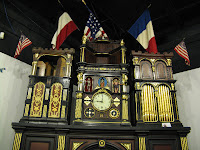
The Engle clock, built Stephen D. Engle (1837-1921) over a 20 year period in Hazleton Pennsylvania. The clock toured the country for 70 years until 1951. It now chimes, marches, parades, peeks, whistles, plays and otherwise entertains at the National Clock and Watch museum.
High noon rolled across the country in a slow, even pace without a care for standardization and that was good enough until the country went from rutted dirt roads to smooth rails. With the extension of the railway system a person could move at such speed that the hodge-podge of times became a problem. The train couldn’t leave Philadelphia at 8 a.m. and arrive at its destinations for orderly departures without a regulated time system.
Along with the railroad system, telegraph companies stood on the side of time-standardization while others resisted holding instead to the belief that God didn’t intend for time to be defined. The sun at its peak each day was timely.
In 1870 there were 80 time zones based on the parade of shadows on sundials. By 1880 there were 56 time zones. Over the decades, as miles of train track grew, the number of time zones decreased. In 1883 the General Time Convention approved standard time zones in North America (4 in the US and 5 in Canada). On November 18 that year during “the day of two noons” the system was adopted by many people. Some communities resisted standardized time saying it was “unnatural” but over time most people accepted it so that it was mere formality when a 1918 law established standardized time.

I learned this at the National Clock and Watch Museum in York Pennsylvania where odd time pieces tick and chime with myriad pendulum heartbeats and fanciful bells in clocks tall and small, plain and fancy.
I live among clocks –grandfather, grandmother, regulator, schoolhouse, mantle and more – clocks that require a Saturday morning ritual of pulling chains and turning keys to renew the kinetic energy that keeps home time marching on – clocks built by my husband Rick. Surrounded by clocks I never thought of the fight behind establishing the right for our clocks to chime the quarter hour.
Stranger still to me was the whole Japanese concept of time using 12 segments of time – 6 in the day and 6 for the night. In the summer the daylight hours stretch but in the winter the evening hours dominated. Correspondingly, Japanese clocks were built with sliding numerals to stretch or shrink the “hours” to fit into the patterns of day and night. No matter how long the day or the night, each held 6 units of time.
This too was based on religious beliefs. People were called to prayer with one, two or three chimes so time was marked with four to nine bells with noon and midnight marked with nine bells each. God changed the length of day and night so people changed the length of hours.
In 1873, outnumbered by those following the western system, Japan accepted the 24 equal hour divisions for each day and redesigned and imported clocks.
The National Association of Watch and Clock Collectors regards time keeping as both an art and a science. It seems they are right. Museum hours change seasonally. Admission. www.nawcc.org/museum

The Engle clock, built Stephen D. Engle (1837-1921) over a 20 year period in Hazleton Pennsylvania. The clock toured the country for 70 years until 1951. It now chimes, marches, parades, peeks, whistles, plays and otherwise entertains at the National Clock and Watch museum.
Monday, June 29, 2009
Health Care Rally in Washington DC

Washington: Medical insurance companies attract anger like Velcro captures lint. Who, of those clutching tightly to their own health insurance, hasn’t waited while doctors file with some desk jockey for permission to do a medical test? Who hasn’t heard about someone fighting to get out of the tight spot between doctors needing payment and insurance companies stalling? It’s time to clean up some of the health care mess so on June 25th approximately 25,000 American citizens traveled from nearly every state to form an army of citizen lobbyists demanding lives over dollars as the US looks toward health care reform.
Senator Chuck Schumer was opening speaker, seemingly cheerleader, with wildly enthusiastic and mercifully brief comments to the crowd steaming in the sun at Senator’s Park in front of the capitol building. Schumer declared that it’s time to change business as usual in health care. What does Schumer want? A strong public option for health coverage for everyone. Schumer shouted, “The greatest country in the world should have the greatest health care in the world.”
As the New York State Senate is mired in conflict that has business in Albany flailing, it seemed that that people’s voices may actually be heard in Washington. Senators Schumer and Kristen Gillibrand as well as Representative Eric Massa are on board with proposals to bring an aggressive public option to health care in the US.
The most recent polls show that at least 72% of Americans want to have a public option for health care. What’s a public option? Some call it Medicare for all in trying to explain the goal but others call it socialized medicine when trying to protect the status quo.
Why isn’t it socialism? Because the government won’t employ the doctors or own the hospitals but rather hospitals and doctors will be independent as they are now. Because people will have their choice of doctors, clinics and hospitals. Since nothing of the system would be run by the government, there’s nothing of socialism in the plan.

Speakers at the rally from workers to pastors to small business owners said that they hate that insurance companies decide on treatment options. They hate that insurance companies decide who they will insure and set the rates without oversight operating in a near-monopoly situation.
What the House and Senate are looking at are bills that would allow people to opt into a public program similar to Medicad. People could choose to participate the same way that people can choose public or private schools or the public post office or private mail carriers such as UPS or FedEx. In the same way that public and private can co-exist in those business models, public and private health insurance can also fit into the market place.
Possibly shining stars in the language are passages that take the dreaded “pre-existing condition” problem out of the conversation. With the public and private models in competition and with companies no longer being allowed to consider pre-existing health problems in their billing structure citizens should benefit. Another change is that coverage would have to include preventive care.
Senator Sherrod Brown of Ohio said that America needs a health care system with a strong public option but that the health insurance industry is claiming that the government can’t do anything right. “If so,” said Brown, “why are they afraid of a public option?”
Brown and Schumer along with Rockefeller, Leahy and dozens of other senators all declare that having an option for public health care would increase competition, lower prices, improve quality and benefit consumers. Massa stepped through the numbers to show how the program could be paid for by shifting money that’s already out there in the health industry – using it to pay doctors and not insurance corporation big wigs.
The public health option is good for the economy – perhaps closer to necessary. Many senators and representatives stated that the economic recovery is hindered by the health care crisis.
Under the current patchwork program nearly 20,000 Americans die every year because they have no health insurance. Worried about expenses, they ignore problems or fail to treat chronic disease and die early. According to the Institute of Medicine, the US is the only wealthy, industrialized nation that does not provide health care for all citizens.
Saturday, June 20, 2009
iLoves iPod

Not long ago iTunes was a foreign concept; the iPod a device of mystery and podcasts of no more importance than a mote of dust among the billions on the computer monitor. No more. The iTunes logo is prominent on my desktop. I’m a regular in the iTunes store and iPod goes where I go. I’ve become a podcast junkie.
Now everyone over 30 has rolled their eyes in contempt and turned away so it’s just us older folk left. Go now - download iTunes. It’s like a Bergren Forum lecture series available 24/7 at home on your computer or anywhere in the world where an iPod may whisper in your ears.
I bought an iPod because when we travel Rick likes to drive with the radio off. I, on the other hand, wish to be aurally entertained.
Emilie encouraged me certain that I would like an iPod and Jay said it was easy to understand. My friend, Susan, said that if she could download podcasts, anyone could. Buoyed with their reassurance and enthusiasm I ordered an iPod - engraved - Elaine Hardman, CEO StoneFlowerPottery.com.
ITunes is a free download offered with the Barbie-Doll philosophy which is that people will buy things to go with the free system. Not willing to disappoint I started with the iPod and added a docking station so I could listen in the studio and then needed a case to protect it and finally (or not) new headphones for comfort.
Ready to make nice with this technology I began by ripping the Dixie Chicks. I don’t actually know what ripping is but iTunes asked if it might perform the service when it registered presence of a CD and then it sped through the music. When it finished, the screen showed each song title, length, genre, artist, recording date and the name of the album. It even, as if my musical opinion mattered, allowed me to rank the songs with zero to four stars.
I ripped through every CD in the house including AU Concert Band music that I needed to become fluent with and all the great music from Emilie and Josh’s wedding. With the historic cowboy music Jay found somewhere and lots of old rock tunes it added up to 1270 songs in one day.
Either iTunes or the iPod can sort and play by many criteria and it will just play and play and play without juggling CDs. Who invented this thing and why didn’t they tell me sooner?
After ripping I dove into the iTunes store where it seems that the best stuff they offer is FREE. That’s my kind of store.
Waiting for me now are nearly 558 podcasts (19 days of steady listening) including 13 short lessons in conversational Spanish and countless lessons on technology and science. If I wasn’t born a geek, I have evolved into one.
While walking through Wellsville one week doing errands the Vinyl Café visited my ears. The VC is rather like the Prairie Home Companion but set in Canada and featuring Dave and his friends. In this particular episode Dave acquired and faced his fear of rats and brought one home for the kids after being locked in the trunk of his car with it. I likely looked the fool laughing while picking up toothpaste.
This American Life is often, and deservedly, at the top of the podcast download list. It’s always interesting - so interesting that I donated to the show because it’s just too good to be free.
Podcasts aren’t all fun and games. There are programs about philosophy and debates on moral questions. CBC radio offers Quirks and Quarks as well as Ideas. In the political arena I like Rachel Maddow’s information but not Bill O’Reily’s vicious streak. For balance I listen to Left, Right and Center. For daily living advice there is Stuff You Ought to Know and Stuff Your Mother Taught You. For emotional and human interest there is The Moth - a series of programs with real people telling about themselves or family members. One can download whole books and listen while walking the dog or weeding the garden.
My exercise videos nestle into the 120 gig hard drive along with a photo album, all that music and days worth of podcasts and vodcasts (videos) and yet 80% of the drive is empty, waiting for more - and it all fits in my pocket.
iTunes holds a marvelous world of information and entertainment with podcasts that are like winning the information lottery every day. The computer makes it work, the iPod makes it portable and all kinds of things make it really worth having.
Sunday, June 14, 2009
Coup in New York Senate

The spectacular New York State Capitol building stands glorious and stately. It’s a building to be proud of but civic prides stops at the magnificent doors. Inside the halls feel slimy with the corruption of “pay to play”.
As of January, Republicans had 40 consecutive years of majority in the NY Senate during which New York’s “Empire State” image decayed. Democrats took over in January and several bills to benefit the general public made it into committees, a discussion series that was meant to culminate with a celebration of democracy – public hearings that would send bills to Assembly and Senate floors.
On Monday the Assembly Standing Committee on Insurance and the Senate Standing Committee on Judiciary met publically. On Tuesday, buses from around the state were set to bring citizen groups to several more hearings when legislative directives supported by up to 70% of the state’s voters were expected to be passed to the full floor with probability that they would become laws.
Now forget that for-the-people stuff. Instead, a Florida billionaire strode the Capitol’s halls making arrangements with New York’s legislators, an entourage of suits jogging in his money-power wake.
Tom Golisano, founder of Paychex, a NY business worth billions, said that New York’s tax system was too high and he moved to Florida. Even though he moved, he reportedly poured money into legislative campaigns to change the leadership in the Senate where Republicans have led the agenda and created tax codes for decades.
According to the Buffalo News, Golisano was dissatisfied with tax rates and with the staffing of the Senate’s Buffalo office so, reportedly, Golisano tugged on his financial ropes to bring politicians to his way of thinking leading to a coup in the New York Senate.
Golisano was photographed with Pedro Espada and Hiram Monserrate who announced they would caucus with the Republicans. Why is this a big deal? There are 30 Republican and 32 Democratic senators - a majority margin of 2. With Espada and Monserrate crossing the aisle to the Republican side, the majority structure flipped. The majority party chooses who will chair each committee and those chairs choose what legislation to consider and what to send to the shredder. The majority party can kill bills by simply not allowing them to come to the floor.
It is also no small matter that the majority party draws the lines for legislative districts, a deed regularly done with regard not to community lines but to party lines thereby ensuring the reelection of the majority party (gerrymandering). Republicans have controlled those lines for the last 70 years.
Changing the majority meant changing all committee chairs and cancelling all the hearings scheduled for this week “for the people.”
According to officials of Citizen Action NY, corporate lobbyists outside the Senate Chamber cheered as the Republicans declared control of the Senate on Monday. Republican control likely signaled job security for them with the “Pay to Play” culture in Albany for lobbyists and bad deals for millions of work-a-day people.
The busloads of citizens took their meeting rooms in a spirit of anger rather than excitement over being involved in the political process. About 100 people from Citizen Action NY protested outside the office of Pedro Espada just after Golisano exited.
News crews from all major stations filmed the group and recorded statements, both prepared and impassioned off-the-cuff, while the majority of citizens stood behind them holding placards and wearing tape over their mouths to illustrate that the voices of the people have been cut from the process. After the statements, they tore the tape off and chanted “Golisano pays, Pedro plays.”
”

Citizen Action of NY then occupied the office of Hiram Monserrate until he met with them. Monserrate, while he has personal legal problems outside the legislature, had worked with several citizen and labor groups to sponsor the legislative measures that were to have been ushered out of committee that day. Monserrate told Citizen Action NY that he would work with the Democratic Party to try to find a resolution to the stalemate and on Wednesday he refused to caucus with Republicans instead meeting with Democratic senators.
For the rest of the week there were protests in Buffalo, Rochester and Albany and negotiations among lawyers for both parties. As of Friday, the legality of the coup remains under discussion, government work has halted and those who hoped that clean elections would come to New York are once more disappointed.
On Monday, Hiram Monserrate returned to the Democratic Caucus resulting in a 31-31 tie thus sending the decision of leadership to the courts.
Subscribe to:
Posts (Atom)


