Thursday, October 5, 2023

The Wolf returns to Denmark

     In about 1812, wolves disappeared from Denmark. It wasn't a magical disappearance but a dedicated hunt brought about by farmers with chickens and shepherds guarding flocks. In medieval times, the body of a dead wolf was hung in the town gallows for all to celebrate but, later, a private shot in the head would do. Them, in 2012, the wolf was returned to Denmark.  This show focused on the wolf in the Round Tower in Copenhagen. explored the history and the current story. 


      In fairy tales, there is a wolf who tracks Little Red Riding Hood. Some version of the story has been found in French in the 10th century. The one familiar to Americans is likely the German version by the Brothers Grimm. An Italian version is called The False Grandmother and there is an ancient Chinese story called Lon Po Po. Ed Young translated that in 1989. 

     The wolf might chase a little girl or go after house building pigs in stories but the threat to livestock is a real world story, one seldom mitigated by the ecological benefit of wolves. That story is in the documentary about bringing the wolf back to Yellowstone. (www.youtube.com/watch?v=kQGKuPbi1EY)

    Both sides of the story were presented. As is often the case, I got caught in the story and forgot to take many pictures. The exhibit of dogs from tiny to huge was striking and also a little upsetting. I did look for a sign indicating that no dogs were harmed in the creation of this exhibit. It may have been there in Danish which would have been only mysterious notations to me.


Saturday, September 23, 2023

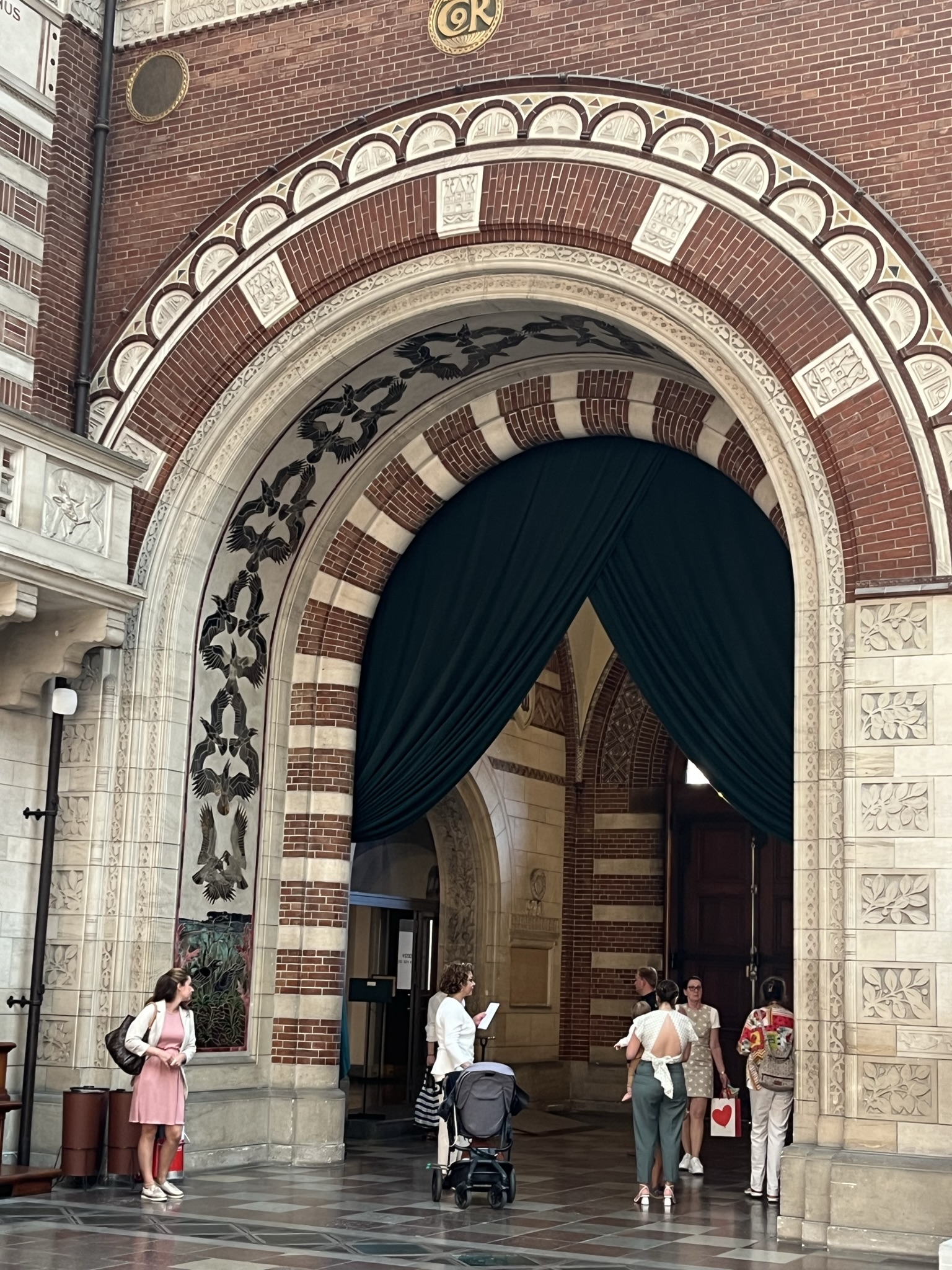
Copenhagen City Hall


 Any building with a door this beautiful has to be worth a trip inside. The first thing we saw in the City Hall was the perpetual clock designed by Jen Olsen. That was worth the visit in itself.


There is a separate blog on this clock built to run for thousands of years.


This door, with the striking brass plates, is inside the building and through the glass, you can see a stained glass window in the stairwell.


These are images from the courtyard. Europeans know how to create beautiful doors and doorways.

I'm going to put several images below to give an idea of the lovely details in this building. Of note are the graceful trash cans and the beautifully painted walls in the stair wells. 

With a mural of early days in Copenhagen there is an image of a person hanging in a gallows. There is no great deal in this portion of the mural but it is clearly a person. This was how thieves were dealt with in earlier centuries. One thing that we later learned is that if a farmer killed a wolf, the wolf would also be hung in the gallows. Apparently farmers, particularly sheep farmers, were adept at getting wolves because Denmark had none for quite a long time. They were recently reintroduced and the populace, particularly the shepherds, seem unsure that they are willing to share space with wolves.


Jens Olsen's Fantastic World Clock

     Clock is a small, innocent word. Most people reading it might think of a small little alarm clock or an old digital clock radio. I imagine the clock Clement Hurd drew in Good Night Moon.

      Of course, one might think of something spectacular like Big Ben but rarely would anyone think of a masterpiece like the Jens Olesen  (1872-1945) clock. In 1897, when he was 25 and saw the astronomical clock at Notre Dame, he decided to build a perpetual clock. Decades later, his youngest grandchild started this clock in motion.


      I'd never heard of Olsen's clock before seeing it. We went to the Copenhagen City Hall because the building is gorgeous (and free) but from that day, I most remember this clock. 

     I was immediately taken by the lovely, golden brass works visible all around through the clear case. Like a sculpture, it draws one around and around. Olsen planned for the works to be covered and only have the faces visible. Whatever was he thinking? 

     After staring at it, I started reading the signs. What staggered me more than the beauty was the fact that it takes 25,753 years for one of the small gears to make a complete revolution while the fastest gear turns once every 10 seconds. 

      Since the clock was started on December 15, 1955, the accuracy of this is still untested but think of the precision of the works where one part revolves a complete turn in 25,753 years. Agog? Right?

     Jens Olsen was a locksmith in 1897 when he became inspired to design and build an astronomical clock. He learned clockmaking and built and repaired grandfather clocks, pocket watches, and binoculars while, in his spare time, he designed the world clock. Here are some details:

My favorite face - the planets

     Olsen made plans for the clock working alone until 1928 when  astronomer Elis Stromgren joined the project. Drawings for the clock were made between 1934 and 1936 but the production was delayed by fundraising and WWWII. Finally, the clock was built between 1943 and 1955- a portion of which included the Nazi occupation of Denmark.

      The clock has 12 movements.

     There are 15,448 parts.

     In spite of it starting the same year as the atomic clock was invented, it is mechanical and needs to be wound each week.

     Displays include lunar and solar eclipses as well as the positions of the planets and their moons. It shows “true solar time,” the Julian period, the date in the Gregorian calendar, and time zones as they were introduced in 1884.


      The city of Copenhagen helped to finance the construction of the clock. It became a symbol of Danish craftsmanship.

     The case was designed by Gunnar Billmann Petersen. He chose to create a transparent case and feature the workings as well as the faces. Good choice.

     While we live in a world where technology becomes obsolete before things are delivered and packages opened, this clock is meant to tell the time and date for thousands of years. The sign at City Hall states, “The World Clock…will still be able to show the starry sky above City Hall, the date when Easter Falls and the time in Singapore.”


Thursday, June 22, 2023

Stepping in Style with Hamilton's Shoes, circa 2002

An article written in about 2002


Stepping in Style 

Take a good look at this old photo of Hamilton’s Shoe Store.  The name of the building proudly adorns a rooftop attachment with ornate splendor. It‘s easy to envision the removal of that adornment either when it became unstable or when the building name was changed but what about the steps? That building doesn’t have stairs now. What happened? Did the level of the street change?  Are there old steps buried under the sidewalks? Nope, nothing as easy as that.

The original Baldwin Block Building, now the Ebenezer Oil Building, had stores on the first level and a door leading to the upper level theater with a stage and auditorium seating. The back of the building came down decades ago and the rest was transformed into offices. The corner store was a bank, then the Newhouse Shoe Store, and finally Hamilton’s. 

Early in the 1900s, theatergoers and customers used the stairs but those stairs also attracted unemployed people who would sit and while away the time, interfering with foot traffic. The landlord responded to the merchants’ needs by bringing their floors to street level. Evidence is behind the basement door at Hamilton’s. Like a flood water level recorded for posterity, this wall sports white paint showing where the first floor level once was and no paint where the wall was originally in the basement.

Workers detached the floor from the building, cut the steel supports in the basement and lowered the floor. The ceilings and windows were once reasonably placed but, with the floor lowered several inches, the windows are now so high that anyone would need a ladder to look out. A drop ceiling was installed but there’s plenty of headroom left.

Amazingly, all the work was done around scheduled business. Stores didn’t close for even one day because of the reconstruction. At Hamilton’s, the customer was always right and the store was always open. Now, that’s extreme service and a legacy that Rich Shear tries to live up to.

Rich followed his father into the business.  Dick Shear could have gone to Colgate or Alfred U with a free ride courtesy of his football skills but his dad died when there were still two kids at home so Dick took a job at what he called the Newhouse Shoehouse to help support his younger brother and mother.  The elder Mrs. Shear was a hard-working, German  person who was up and baking long before most others in Wellsville stirred.  Every morning by six, she had a smile on her face and finished pies on their way to Scoville Brown Grocery.   

In 1928, Newhouse sold the shoe business to William Hamilton for $2,200.  Mr. Hamilton changed the name of the store but kept young Dick Shear.  Dick was the people-person at Hamilton’s and William provided the capital.  Dick Shear wore out shoe leather and treads as he learned and changed the business.

Bach then, the local businesses bustled.  In the ‘30s, ‘40s, ‘50s and even into the early ‘60s, people bought locally.  Yes, cars became common over those decades but traveling to purchase things didn’t. The Sears catalog was full of great stuff but if you really wanted shoes that fit, you went to a pro.  At almost every shoe store, both feet were always carefully measured and, for several years, an x-ray machine was used to give the inside picture of the fit. 

During the time that he was in charge of making sure that people had comfortable shoes, Dick Shear developed a method of creating felt pads to customize shoes.  He knew that people don’t have perfectly matched feet and that most people needed modifications glued into one shoe or the other.  He also learned to use a set of antique stretchers to customize shoes.  It’s uncommon to find stretchers like these in use anymore.  The stretchers can help get a new pair of shoes “broken in,”  preventing blisters and adding comfort.  Rich Shear sees the stretchers and the custom-fit pads as components of a customer-service ideal that he strives for. 

Dick Shear brought service to his customers even if they didn’t come to the store.  He would send out notices of his schedule and then take a car full of shoes to a room at the Sherwood Hotel in Hornell, the Olean House, or hotels in Coudersport or Smethport.  During the day, people tried on what he had and if they needed a larger or smaller size or a different color, they came back in the late afternoon when someone from the store brought out the needed items.  The service, offered twice a year for over twenty years, faded away as hotels closed and customers became more mobile.

Rich has worked at Hamilton’s since 1967 when he started learning to make pads and fit shoes while still in college.  Following his Dad’s example on a smaller scale, Rich, when asked, takes shoes to customers at nursing homes.  He also has fourteen drawers full of catalogs in the back of the store so, if a customer doesn’t find the right footwear in one the 3,000 shoeboxes covering the walls, Rich will custom order the right shoe. 

Footwear has changed over the decades.  One big thing is that it is harder now to predict how a shoe will fit.  Shoes were made in the United States when Rich started (women’s shoes in St. Louis and men’s throughout New England) and there were standards – a size six was pretty much the same for any company. 

Now shoes are made in Asia and South America with sizing that varies from manufacturer to manufacturer.  The variety in sizing makes measuring, fitting and modifying important, but hard to find, services.

There’s been a big shift in style.  Years ago, many shoes were ordered in narrow sizes.  “We would order women’s dress shoes in quadruple A.  Have feet changed in one generation?  No.  Women just jammed their feet into these narrow things.  They didn’t ruin their feet but they were uncomfortable for years.  Now there is more acceptance of the rounded-toe, Euro Style and more concern for comfort.”

Another shift is that athletic wear, once a small section in the store, now  commands nearly a full wall.  Rich offers his experience as a runner to help other athletes.  He considers the person’s biokinetics, analyzing how the runner moves and helping to select the best shoe to address a problem.

Hamilton’s has always tried to provide mid to high quality footwear from a variety of manufacturers while giving attentive service to their clients.  Early in our lives as Wellsville residents, my husband gave Hamilton’s a try.  City and mall shoe stores often told him that they didn’t carry his size but Hamilton’s made special orders.  

Among Rick Hardman's favorite small town memories is the day that he was pumping gas when someone yelled out to him, “Hey, Rick, your shoes are in!”  

Events like that makes small towns feel like home.  Hamilton’s has been a part of this small town for 74 years.


Sunday, June 11, 2023

JW Embser & Sons Funeral Home and Sedan Ambulance Service.

       In about 2003, I went to Embser's Funeral Home with a bit of nervousness. The last time I had gone it was to preplan a funeral but this time it was looking for a story. Still, walking through those doors brings back memories of every time I entered the building. 
     This visit was interesting and made me feel better about every funeral ahead of me. Did you know that it was once Embser's Funeral Home and Ambulance Service?  They had an ambulance but also could hook up sirens and lights to the hearse if they needed to use that.  They drove people from accidents to the hospital and transferred patients from Jones to Buffalo or Rochester.
       At the time, Jones was the Jones Homestead, a Victorian house near the current site.  There was a dumbwaiter in the building that could be raised to the level of the ambulance/hearse making it easier to get people out of the vehicle.  Sometimes people called for a ride just because it was an available transportation from out of the hills into town.


WELLSVILLE, NY:  As a child growing up in Buffalo, I saw sleek, station wagons speed by, chasing cars to the side of the road with their flashing lights and screaming sirens. These wagons had a special function, not for soccer moms or grocery delivery but for medical purposes, they were the ambulances of the 1950s and ‘60s. Painted in varied designs and colors to indicate their operators, they were owned and operated by hospitals in Buffalo. At that same time, in small towns like Wellsville, funeral homes met that need. In Wellsville, one operator was JW Embser & Sons Funeral Home and Sedan Ambulance Service.
     Why connect a funeral home and an ambulance service? Well, both had vehicles that could accommodate a person needing to lie down in the back.

        John Embser remembers riding along with his dad in their ambulance. For John, those rides had all the drama a kid could want with the pulsing red light on the roof and the wailing siren behind the grill. John especially remembers one trip to Scio to take an eight-year-old boy to the hospital. John, about the same age, sat in the back with the boy to hold a cloth against his bleeding forehead. This was all before the days of EMTs, biohazard fears or even seat belts.
            David Gardner, John’s uncle, remembers the ambulance days differently. His memories are of the responsibility of transporting injured or ill people at all times of the day and night. He said that sometimes they’d sit down to eat dinner and the phone would ring and someone would call out, “Well, there goes Dad again.”
            The passengers in David Gardner’s ambulance went to an early version of the Jones Memorial Hospital. While most people went to Jones in a private car, people without cars or those with serious illness or injury would call Embser’s for transportation. 
            These trips were tough work when people needed to be carried down steep, narrow stairs on a stretcher. Generally, David Gardner would call someone to ride along and help. Often it was a car mechanic interested in earning a few extra dollars. Sometimes it was a friend willing to get up at two in the morning and drive across the county to help carry a heavy person.
            Occasionally the drive was a scheduled event, bringing someone to Buffalo or Rochester but more often it was a sudden event. It was meant to be discontinued when actually ambulances available through the fire department or through an ambulance service but when older customers called Emser’s to ask for a ride to an appointment with a specialist, they were never turned down. Courtesy has always been a pillar of the Embser family.
            The Embser Funeral Home and Sedan Ambulance Service grew from a business started in 1913 when JW Embser left his job at Rauber’s Furniture and Undertaking to begin his own funeral service. At the time, furniture builders supplemented their income with the construction of caskets. They also had the extra chairs one would need during a wake. The connection between funeral service and furniture was common for a long while. An Allegany County Directory from 1905 shows 18 funeral homes with 12 of them also listed as furniture stores.
     JW’s first hearse was drawn by horses, flanked by lanterns with stylish drapes over the side windows, and filled with all that was needed.  JW had learned embalming as he worked for his employer. People generally died of illness or accident, usually at home. Maybe a doctor would be there, maybe not. The family would call the undertaker and he would “under take” the arrangements for home, church and cemetery.
     In the bedroom, the body would be washed and prepared. A gravity feed system would drain the body and siphon the embalming fluid (a formaldehyde solution to control moisture and, one must say, odor) into the body. The fluids removed from the body would be carried by bucket to the privy for disposal. Afterward, the deceased would be washed and dressed.
     The next big task was to prepare the parlor. JW had a service wagon in addition to his hearse. The service wagon carried drapes for covering the windows, satchels with a crucifix and candles, and a special table to hold the casket. Chairs were carried in the service wagon, packed in canvas, six to a bag. When the room was properly arranged with all in place, the mourners would arrive.
     A religious service was generally carried out at home but often there was a second service in a church. The horse-drawn hearse transported the body there and, while the clergy comforted the mourners, JW would go to the cemetery and erect a tent over the hole, paying $3 to the hole diggers. JW arranged chairs there, too, and installed the apparatus for lowering the coffin.    
     Afterwards, JW returned to the home to remove the service table, chairs and drapes, reclaim things from the cemetery and tackle the paper work of death.  All of his efforts brought him $20.
     The first service performed by J.W. was for an infant, Pearl Van Kuran. Pearl lived from August 26 to September 6, 1913 and was buried at York’s Corners. Paging through the old book shows that business was slow at first but by 1917, the influenza epidemic had his funeral service bustling. Gravediggers were earning $13 and casket makers asked for $100.
     Eventually, the horse-drawn wagon and hearse went into long-term storage and JW purchased a new, gasoline engine hearse. This hearse maintained some of the style elements of the old horse-drawn buggy with faux pillars along the side windows and the same stylish curtains over side windows.
The new hearse strained the business financially because, while a wagon could be traded for another wagon, it wasn’t something that the automobile dealer was interested in.
     The second generation of Embsers in the business, brothers Walter and Richard, worked in a different world. They learned their trade through formal classes as well as experience. Walter and Richard expanded the operation by introducing the sedan ambulance service.
David Gardner ushered in the third generation after he earned certification as a funeral home director, through formal education  in 1962 and John Embser joined later.
     Generation four, Walter Gardner, earned one degree at SUNY Canton and another at SUNY in Utica. Canton’s program offers a Bachelor of Technology degree in Health Services Management:  Mortuary Science. The program, including a full year of internship, shares several courses with nursing students so that funeral home directors are now more knowledgeable about anatomy than ambulance drivers were a generation ago.
     Earning a degree isn’t the end of it, either. Funeral directors must participate in continuing education seminars and renew their licenses every two years. They develop and maintain proficiency in the embalming process as well as with aspects of business, rules and laws.
     alking with multiple generations of practitioners makes it easy to see how the profession has changed. The embalming and the ceremonies have moved from the home of the deceased to the funeral parlor. The caskets are no longer standard items but are available in virtually unlimited materials, designs, colors and themes. The cost has changed too. Rather than having one flat fee, there are itemized charges for each service, many of which simply pass over the funeral director’s desk. For example, the charge for opening a grave goes directly to another agency. The job, once costing $3, now fetches $350.
            A major change seems to be the option to preplan a funeral. The planning can be done at any time and with any amount of detail. The advantage is that a person can make their wishes known, state their preferences, and remove stressful decision making for family members. All of this can be done leisurely, without the huge, emotional impact of death.
            The whole funeral scenario is serious business but checking some of the coffin styles offered over the Internet shows that some people put creativity into the situation. One website offers a casket painted to look like a set of golf clubs.  Others were painted with sport or religious themes. There are standard models in a wide range of colors. I also found a not-so-standard model that comes outfitted with shelves. It can be used as a bookcase until needed as a coffin. The shelves come out and a liner with pillow pops in.
         Of course, for those who choose cremation, there is a world of urns including those privately made by potters or other artisans who make the item for a specific person.
     The thing that seems to have remained the same in this business over the years is the emotional impact of dealing so regularly with death. All of these funeral agents feel that it is hardest to work with the families and bodies of children. Some of the preparations that they have made haunt them. Sometimes one of them, overcome by emotions, has had to call for help. At other times, dealing with a long-time friend, they feel that their work is an act of kindness that gives them comfort as they work as carefully and respectfully as they can.
     At the time of this essay, Ember’s was nearing their 90th year of operation. It is on West State Street in what was once the home of JW and Agnes Embser. Their hours are simply any time you need them. them.  
 
      For more on the history of the Jones Memorial Hospital: https://www.urmc.rochester.edu/MediaLibraries/URMCMedia/jones-memorial/services/images/JMH-History-booklet_1.pdf
      For more on the creation of the modern paramedic program listen here: https://thisiscriminal.com/episode-222-the-paramedics-6-8-2023


Saturday, June 3, 2023

Norm Ives, The Snake Man

 When someone posted one of Norm Ives' poems on Facebook, I remembered writing this article when Norman moved to the Wellsville Manor. His family asked if I would spend time with them and write about The Snake Man. I'm not certain of the date.


            No spin or slant can bend this truth:  things change, eras end.  In Wellsville, Norman Ives, The Snake Man, has changed his life and ended the era of his reptile show. He will not drape Beauty or any of his other soft, smooth friends over our shoulders again. Someone else will buy the mice, feed the snakes and encourage benevolence toward creatures that glide through fields feasting on rodents and laying their eggs in warm, damp places.

            Norman has loosely scheduled days now, days of visiting and remembering. He watches red squirrels raid a hummingbird ball outside his window. Sometimes he recites poetry or talks of murals, drawings, photos or carvings he’s made. Norman Ives’ life is woven of family, nature, animals, poetry, teaching and art so that’s what we talked about one day in June of 2007 with 6 of his family members in his room at the Wellsville Manor.

            Norman was born in Wellsville on March 7, 1923. His mother died when he was a tot and his brother, Elvin, was just 5 days old. Their father was working in the salt mine near Genesee and couldn’t take care of two little ones on his own so they went to live with their aunt and uncle on a hill top farm in Alma.

            When Norman was in elementary school, he occasionally got into trouble. “If you don’t stop drawing and start writing and studying,” the teacher would tell him, “we’ll keep you after school, Norman.”

            He stopped drawing often enough to keep the teachers happy and to graduate from 8th grade. As part of that process, he had to take exams in Genesee and that’s where he met Lela Ellsworth. Norman remembers Lela telling people that every time she looked up Norman Ives was staring at her.  As he remembers it though, every time he looked up Lela was staring at him. After 8th grade, Norman “took off for Salem County, New Jersey.”

He spent 4 years there with another uncle and came back to Wellsville with a high school diploma. He worked in an oil field and on a farm and then joined the Army for 3 ½ years as a medical technician. He planned to become a registered nurse but he dated then married Lela so his Dad helped him get a “temporary” job at PreHeater. He and Lela wanted to be financially set before he went to school. He worked and they built a “beautiful little house on the hill in Alma.” The temporary job lasted 38 years.

Norman worked in the element division and then was in charge of inventory and distribution in the plant and finally traveled the country to check on how the elements were functioning in use. 

Lela was pleased to look at Norman but not at snakes. Once when he was working the yard, she screamed so he came running to her. An Eastern Milk Snake was sunning on the back step trapping Lela in the house. Even after he moved the snake, Lela wasn’t sure she’d ever enjoy using those steps again. 

            While she fretted over the snake, Norm measured it. It seemed awfully large for an Eastern Milk Snake. Sure enough, it was a full 40 inches long. Norm called the DEC and they verified that was the longest Eastern Milk Snake ever reported in the area. Norm has kept track over the years and as far as he knows that snake still holds the record.

            Norman and Lela had 3 children – Laran, Richard and Norlene.  (Laran was born on Columbus Day so Norman wanted to name him Laran Christopher but Lela filed his name as Laran Norman.)      

            Norman was a member of PreHeater’s Bowling team for 53 years. A nasty landing on ice a couple of years ago ended his smooth bowling stride as well as his annual hikes in the Ridgewalk. His community activity also included decades of work with the Thelma Rogers Historical Society, Creative Writers, Wellsville Art Association, Allegany County Bird Club, the Keystone Reptile Club and others.

            Through all the years and all the children and grandchildren (Valerie, Richard, Hillary, Christopher, Michael, Jason and Kaelene) and the community involvement, Norman rescued animals.  That’s what most people know about him.

            The DEC gave him permission to raise a pair of stranded red-tailed hawks. He found them parentless when he was hiking and took them home. He caught or bought mice and rats to feed them and then put up a large cage to train them for release. Betsy Brooks in Alfred banded the birds and he released them with hope that they would adjust to the wild. He learned that the female died two years later in Alabama but there was never any word on the male.

            Norman’s porcupine story can’t be beat. He was crossing a road and found a female porcupine – road kill. The impact of a car had torn her body open but her young was still alive so Norman tied its cord with a shoe string and took the little guy home naming it Needles. Needles was gentle and friendly and had the run of the house for about two years.

            One night, Norm came home and found that Needles had yanked plants from their pots and had started to generally destroy the house so Norman and Needles went for a long hike but only Norman turned around to come back. Needles took off with nary a thank-you glance and he’s not been seen again.

            Lela died when Norlene was only 6 so Norman cared for animals with the help of his children, grandchildren and sister-in-law, Joann. Joann isn’t any fonder of snakes than Lela was but she drove Norman and his crew to reptile shows willingly until a snake got out and crawled up from under her car seat. Snakes roaming in the car are not her cup of tea.

            The reptile show had a lot to do with Beauty who came to Norman by chance after he watched a Black Rat Snake lay a clutch of eggs in sawdust in a field. He took a photo of 14 eggs and went back the next evening to see how the nest was faring. It wasn’t. A bulldozer had leveled the area and destroyed all but 1 egg. He wrapped that egg in his handkerchief and took it home.

            He set up an aquarium with sawdust, dampening it every other day and waiting for 66 days. On August 16, 1978 Beauty hatched. Just a few days ago, Norman gave Beauty and the others to Pennsylvanian herpetologist Dixie Lixie and then he “cried like a baby.” The end of an era hurts.

Through his life Norman has written poetry - winning awards and being published. He has ribbons and certificates for his drawings, carvings and photos. His poetry, art and his reptile shows have always focused on what is admirable in nature. For 32 years he has been The Snake Man. He has taken snakes into more schools than he can remember always without pay. He has gone to fairs, festivals and almost everywhere he has been invited because “There’s a lot I can teach about the value of snakes and the natural world,” he said.

Sunday, May 2, 2021

Carter Hardware

  This article was written several years ago and printed in the Wellsville Daily Reporter

                                                Carter Hardware

 The bell rang when Dean Graves walked into the store and Kate asked him if he wanted his repaired window screen.  Dean, who’s been a friend and a customer since he was a boy, talked as she went to get it.  “Everything’s here.  If you need a weird little part, they have it and if they don’t, they’ll get it for you.” 

             That “can do, can find, can fix” reputation is as solid as the stone foundation that attaches Carter’s Hardware to 130 North Main.  In the horse and buggy days, circa 1900, A. E. Brandon opened the store to offer service to people and that’s what people continue to find.  Another customer, Dick Butler said, “If I can’t find what I need anywhere else, I come here.”

         My family discovered Carter’s when we moved to Wellsville in 1975.  Our neighbor at the time, Charles Hyde, was at the end of his career there.  He started after being in the 23rd Engineering Corps during World War I and over a period of nearly sixty years, some worked in tandem with John Boyd, Charles learned the purpose for every item tucked in corners and attics of the store owned, then, by Roy Carter. 

         When Roy Carter owned the store and hired Charles in the 20’s, there were no farm supply stores and lumber stores sold only lumber.  For other construction supplies, and to have things repaired, people went to a hardware store.  Carter’s was in one building then, selling wood and gas stoves, farm supplies, horse blankets and collars.  Upstairs, a hoist brought materials to the area where awnings were made to order and, in the basement, were machines for other kinds of custom work.  

    Nails came to the store in one hundred pound kegs and were put into bins under the main counter.  The counter now holds a computer instead of a cash register but the original scale is still there and ready to use, if you’d like to buy a few pounds of nails.

             Those hundred pound kegs were abandoned in favor of fifty-pound cardboard boxes years ago but some of the old kegs with their odd and out-of-demand nails are still in the back, just in case.

            That’s what makes Carter’s such a great place.  All kinds of gadgets are kept around and someone in the store knows what and where they are.  My husband, Rick, has gone searching high and low for things to be told that they aren’t made anymore but, when he comes to his senses and stops at Carter’s, they ask, “Would you like that in aluminum, brass or stainless steel?”

     In the seventies, small kitchen appliances could be brought to Carter’s for repair.  Now people usually throw small appliances away and buy new ones but the wall in the back room is covered with rubber belts and small engine parts.  The paint mixer takes up one corner while the workbench along the wall is the place for repairing vacuum cleaners, lawnmowers and snow blowers or for eating lunch.  On the wall, a list of prices for service can make a person gasp, but only because they are such reasonable numbers.  

     The pipe cutter that Mr. Brandon bought about a hundred years ago is still in service in the basement.  In addition to having pipes cut or threaded, customers can have glass cut, window screens repaired, any kind of saw or cutting blade sharpened and stove pipe crimped on the spot. 

             After Lee Guilford bought Carter’s in the 70’s, he extended the space, spreading the business into the second building, formerly a Sears store.  This allowed expansion of the selection of guns, swords and other sport equipment.

     Lee taught his sons, Jeff and Clark, the business the old fashioned way, by having them work in his store when they were kids.  A photo of young Jeff, surrounded by hardware, hangs between scenes of the store as Charles Hyde knew it.  Jeff took over the operation of the store with Clark several years a go but now he runs it with his younger brother, Zack.  They continued to offer merchandise, advice and repairs.

                 Taking the tradition into another generation, Kate Aronson works in the store part time.  She says there isn’t much of a choice about where you work when your Dad owns a store but that it’s really fun.  She has gained useful knowledge and skills.  She knows what to do with all the machines in the basement and most of the stuff upstairs, too. 

    And, may I stress, there is a lot of stuff.  Just standing on the foot-worn wooden floor at the front door, one can see keys, light fixtures, fans, ant traps, drills, dry wall tools, toy Radio Flyers in different scales, knives, Goop, and plastic floor covers sold by the yard.  A walk down any aisle reveals the reason why Jeff has so many catalogs in his office and why people are so often able to leave the store with just what they were looking for. 

     “I don’t know what it’s called but…” was the start of a customer’s inquiry that, with plenty of hand gesturing, tried to identify an object by its purpose.  In another store, an observer would think that this customer would leave empty handed but here she was patiently heard and led down the correct aisle, just as she expected.

                 Carter’s is open during the week from eight to six and until five on Saturday.  While someone fixes your broken window screen or sharpens your scissors or chain saw, you can find the right screw, nail, bolt or spring for your project, get a new apple peeling machine, select some cookie cutters, have your paint color blended, pick out a fishing pole or get some keys made. 

     Like Dean says, “Carter’s is a great place!”