Sunday, September 7, 2014

Is there leachate on tap?

BATH, NY:  Leachate. Influent. Effluent. Flocculent. Biochemical Oxygen Demand. Some of those words sound uninviting which is fine because what they name isn’t always pleasant. They are all parts of the business of the Leachate Pre-Treatment Plant operated by Steuben County.
           The folks in charge of that facility seem proud of what they have and how they run it. They welcome busloads of high school students and car loads of adults interested in taking a look at what runs through those pipes. I was able to attend as a guest of the New York Water Sentinels, a citizen science stream water monitoring program affiliated with the Sierra Club.
          The tour was hosted by Vincent Spagnoletti, Commissioner of Public Works and Steve Orcutt, Assistant Commissioner and conducted by Bob Kingsbury, Chief Waste Water Plant Operator.
         To digress a moment, people in Allegany County know that Wellsville has a wastewater treatment facility. It is designed to take in what homes flush out; to remove daily domestic muck from sewer water and send their product into the Genesee River.
           The Bath pre-treatment facility we visited is different because it was designed to remove heavy metals and other nasty materials found in leachate from landfills.  The effluent or end product is then piped several miles to the Village of Bath’s sewer system, with final processing by Bath’s wastewater treatment plant before being discharged into the Cohocton River. 
          Entry to the facility in Bath requires a drive past the landfill where sheep and goats graze over the seemingly inactive land. Looks aren’t the whole picture though because under the grass, garbage decays for decades giving off methane gas. In the past, this collected gas was a burdensome waste stream, burned off in a flare.
          Steuben County changed waste into revenue in November 2010. That’s when the Gas to Energy Facility came online. Owned by Steuben Rural Electric Cooperative, this facility captures the methane and uses it to power generators which create electricity to sell to the grid. What was once waste is now the source of power to about 2,000 homes each year.
          The hill side in Steuben County holds the old landfill that, one might say, was not so much built, but dumped on - as was the practice of the day.
          There’s also new landfill, a modern entity with cells and layers of liners following current rules and regulations. It seems wise to locate everything nearby because new or old and regardless of name or structure, every landfill gurgles out some leachate.
            Weather in the form of rain or melting snow sends water to percolate through the soil and garbage where it dissolves some things and picks up organic material, heavy metals and any water soluble material.
          After water has soaked through a landfill it is designated as leachate, a mix of gray or black particles suspended in a liquid delicately giving off a scant scent of rot and chemicals. In Bath, pipes take the leachate from both the old and the new landfills to a storage tank to await pre-treatment.
          In 1995 Steuben County was forced to examine their leachate issue. At the time Spagnoletti considered shipping the leachate to other facilities and paying the asking price to have it processed.  However, while he heard proposals of a penny a gallon fees, he couldn’t get that in writing with a long-term promise.
          Long-term is a certainty with landfills so Steuben County accepted the DEC’s offer of financing 2/3 of the cost of a pretreatment plant.  While they were at it, they overbuilt in order to serve as a regional leachate center processing not only what gravity brings from their landfill to the storage tanks but also truckloads of the stuff from other facilities.
          Kingsbury started this tour near the computer that controls the works but Spagnoletti spent a great deal of time in that room answering questions about how things are tested and what would happen if this or that. He told the history of the project and the tangential projects such as the Gas to Energy.
          In the way that they found a use for the methane gas by-product, Spagnoletti said, they hope to find a company that would use the heat produced in the pre-treatment facility.  They almost sold the idea to a handler of waste material from cheese facilities yogurt manufacturer but the deal didn’t happen.
          Kingsbury spoke of his background and talked about his need to attend continuing education programs and pass exams every 5 years. “The job is challenging, at times,” he said, “but the county government is supportive and we get what we need.”
          As he has gotten to know the facility, he has been able to cut back on chemicals and even eliminate several. Just giving liquids more time to settle can reduce the metals content of the liquid (known as mixed liquor) has been very effective.
          Put into simple steps, this is what happens: fill a tank with leachate and add some lime; shake and mix the stuff; settle it; draw sludge off the bottom; send the liquids another tank loaded with bacteria which further clean the water; then send the water to the local waste water treatment plant.
          They add liquid lime to get the metals (iron, copper, zinc, lead and some mercury) to settle.  After particulates settle and microorganisms finish their work, the stuff on bottom of the tanks (sludge) is pumped off and compacted for return to the landfill.


          It’s easy to share complaints about government agencies but it’s only fair to make clear compliments and kudos when such agencies work well. It seems that the staff at Steuben County’s Pretreatment facility thinks and works for long-term benefits, searches for efficiency, gathers and applies new information, conserves resources and respects staff members as well as taxpayers. 

Clean Water?

WELLSVILLE:  Flush a toilet, wash a dish, enjoy your shower and forget what goes down the drain. That’s what many do every day while a crew of 3 waits “downhill” ready to turn our nasty sewage into river-ready water.
            This past week I stood on some sturdy grates looking down on Wellsville’s daily 1.4 million gallons of sewage as it rushed into the Wellsville Sewer Department
             I toured the facility with Joanne Allen and Barry Miller of Concerned Citizens of Allegany County while Michael Smith and Brad Mattison explained the sewage treatment processes that relieves Wellsville’s sewage of some of our daily muck.

            We started at the headworks, the unit where water from about 2400 users enters the system. This is the place plagued by baby wipes and the occasional diaper. The water passes through a grinder and a screen but things like baby wipes don’t grind well and can block the screen so sometimes someone has to pull out what looks like stiff, white fiber.

            The water that rushed under our feet was raw sewage at its worst but it didn’t smell much. Smith said that’s because there is a lot of water in the system just now. He said that waste water comes from homes, stores and businesses but there is also water that seeps into the system through broken pipes. Pipes, he said, always leak somewhere.
            This water is only domestic sewage. Storm water doesn’t mix in. The Village worked aggressively in the 70s, in response to Nixon’s Clean Water Act, to separate sewage and storm water. At the time there was grant money to upgrade systems and Wellsville took advantage of that money to separate the two water streams.
            After the sewer water passes through the grinder and the screen it goes into an aerated grit chamber where air helps to suspend organics (that’s the polite word) and let grit like sand, coffee grounds, egg shells to settle. There’s a device over the chamber to scoop out the particulate matter that settles. These solids are eventually sent to the county landfill.
            The sewage flows through underground pipes, across the driveway, to the primary settling tanks. Two of these tanks were built in 1937 and the third in 1997. They are all rectangular, concrete ponds with gooey, yellow grease floating in the corners and, while the water is 10 feet deep, there is almost no visibility.  
            The tanks have metal bars across at regular intervals. The bars are mechanical scrapers that travel along the bottom of the tank pushing sludge (another polite term representing various components) toward a hopper. The bars move a circular route up the side, across the top and then down again to scrape the bottom.  Pretty much as soon as they enter the dense water, they disappear.
            These tanks are nearly 80 years old and they look solid. Several parts of the system are that old but it all seems well cared for.
            At the settling tanks, another waste stream is introduced and that’s the leachate from the Hyland Landfill.
            Leachate is water that has dissolved and carried away a substance. Rain that passes over orange peels and manure in a compost bin is leachate as is water than passes over used batteries, gunk from a dirty garage floor, home cleaning or garden chemicals and rotting food or whatever else might end up in a landfill.
            The leachate from the Hyland Landfill matters to members of CCAC because of drill cuttings and waste from hydrofracking wells. The wells are fracked with processed water which can have any of 500 chemicals and the shale formations are known repositories of water-soluble radon.
            30,000 to 40,000 gallons of leachate enters the settling tanks every day but Smith says it’s watered down by all the domestic waste. The staff at the Sewer Department does not measure radiation (alpha waves) and is unconcerned about any levels of radioactivity that workers are exposed to.
            Likewise they do not measure or remove any medications, hormones or other drugs that the people living in those 2400 houses might be pouring down the drain or passing through their bodies. Smith said that some people see those substances as “forever” in water.
            So, at the tanks, the sludge moves off to anaerobic digesters and the water goes to a recirculating building where pumps send it to a trickling filter. This 120 foot diameter tub has a 6 foot deep bed of chunks of limestone. There are 4 perforated arms attached at the center. As the arms turn, water sprays over the limestone and trickles through the stone to eventual aeration and release into the Genesee.
            There is a second 120 foot wide tank with smaller stones that water passes through in the summer. Called a polishing filter, this tank freezes in the winter hence the summer-only use.
            The sludge in digesters continues to break down via anaerobic bacteria. Sludge is added and removed daily but what we saw go in will stay there about 25-30 days. Bacteria are free, but they can’t be rushed.
            Bacteria give off methane as they break down organics and while the methane and volatile chemicals escape into the air freely over the settling tanks, the sludge in the digesters gives off enough methane to make capturing the gas worthwhile. That methane is used to heat the digesters to keep them at a temperature that keeps bacteria working.
            When the sludge is removed it is either put in sheds to air dry or it is squeezed dry in a dewatering press, a machine that looks rather like a printing press. The sludge is pressed between powerful rollers to force out the water leaving behind solids that can be sent to the Allegany County Landfill while the water runs through treatment system again. 
            Every step of the way bacteria works to break down contaminants. Before the water is released into the Genesee, ferric chloride is added so it will bind to phosphorus which is not wanted in rivers. In the 70s water was treated with chlorine but that practice is now seen as harmful.      
             There are some daily, weekly and monthly chemical tests performed on the water to be certain that the facility is cleaning the sewage properly.
            There was a lot of information covered by Smith and Mattison who were generous with their time.  Joanne Allen said that when she saw the amount of equipment and the processes involved, it made her feel better about paying her sewer bill.
            Smith said that people who want to help the Sewer Department run smoothly, should stop flushing baby wipes and dumping grease down their drains. Both create problems, one by jamming up the shredders and the screens and the other by gumming things up.
            The other practice he strongly suggested was to compost food waste. It’s better for each of us to create usable compost than it is to send more sludge to the landfill.


Tuesday, May 13, 2014

Charles Phillip Orlando


BELMONT: Charley and Betsy. Betsy and Charley. So many thought of them together, a partnership brimming with energy, knowledge and creativity, always ready to teach or to learn. On January 23rd, Charley (Dr. Charles Phillip Orlando) died while Betsy held his hand and silence wrapped around them.

            I’d met Charley as Dr. Orlando in 1974 during my job interview for a position as special education teacher at the Allegany County BOCES. I walked into the Learning Center a bit nervous but dressed, I thought, presentably in my new coat-dress. Charley suggested I hang my coat in the closet.

            “This is my dress,” I said.

            His eyebrows strained upward, struggling with disbelief. “That’s a dress?”

            Luckily style wasn’t part of the job so we talked about behavior management, lesson plans, educational philosophy. Hours later I had a new job and had begun learning from one of my greatest teachers.

            My arrival at the Belmont Learning Center came about after my husband joined the faculty at Alfred State College but what brought Orlandos to Belmont? A job, of course.

            Charley was teaching at Penn State in 1972 when he was asked to inform his students that the Learning Center in Belmont needed a director. Instead, he sent his own application and landed an interview. He spent the night at the motel (now the ACCORD building) near the waterfalls in Belmont.

            Arriving late, he found a key under the mat. The room was cold but he showered, dressed (even donning his coat) and burrowed under frigid blankets. In the night, he woke up sweltering. The heating system had turned the icy room steaming-hot.         

            At his interview he discussed not only education but fly and trout fishing. Job in hand, he and Betsy went house hunting. At the time there were only 2 homes for sale in Belmont and neither suited. 

            Still Belmont was the best choice for anyone working work half time at The Learning Center in Belmont and halftime teaching at Alfred University. Locals know that hills dictate road placement so other towns were just not as reasonable for someone splitting time between those towns.

            Luckily a home on Ackerman Hill was listed. It was a mobile home which wasn’t to their liking but the land was wonderful. The previous owner had a runway for his plane, his way to cover a huge service area. Orlandos added another 30 acres to the property and they, their 3 girls (miracles Charley called them) and a parade of dogs, cats, horses and goats moved in.

            Betsy had several years at home and in service groups. She was president of the 4H Committee and Charley took charge of the 4-H horse club. The girls presented horses, goats, dogs, sewing and crafts at the county fair. Over time, Betsy served on the Belmont Library Board, and performed with the Genesee Valley Chorus and the Allegany County Players. They both served as board members for the Allegany Artisans where Betsy is currently secretary.

            Charley was a member of the Amity Town Board and worked as the town assessor. He was on the Alfred State College Council for 17 years and, a person full of ideas, insights and inventions, he was always learning, teaching and supporting his family and friends.

            During those early years in Belmont, the family took 3 westward road trips in a pop top camper. They went to Yellowstone, to Albuquerque, and then back to Yellowstone with a side trip to Glacier Park.

            During the first trip, the family trained in behavior management. Charley and Betsy wore golf counters. They set a timer and if, when the bell rang, all the behavior during that period had been acceptable each girl got a click or 2. If there was a behavioral disruption, they tuned the timer back. Now and then they caught someone being good and gave an extra click. Two clicks were worth 1 cent so that clicks converted to spending money for ice-cream or trinkets.

            Everyone had click-earning jobs at meal time and during camp set up. Betsy said she wasn’t sure she wanted this program, especially for 4-year old Jessica, she but clicked into position as a believer. Consistency teaches and all of them modified their behaviors.

            “We had such good times just being together on those trips,” Betsy said. “We went to ranger talks, read stories around the campfire, worked together and just enjoyed each other.”

             After Jessica started Kindergarten, Belmont Schools asked Betsy to apply for a job. She didn’t think she wanted to teach where the girls attended but she went to the interview. It was her first. She’d never had to have a job interview before.

            Here’s some recent history. There was a time when teachers were hard to find and schools begged for applicants. Interviews included asking women if their husbands approved of their working.

            Betsy was also asked if she would ignore her years of experience and accept beginning pay. No, said Betsy, she would not. After a different job interview, Betsy began teaching Kindergarten in Rushford to the great benefit of many children and several adults.

            Betsy provided experiences in her classroom. Many children arrived for Kindergarten never having used crayons or scissors, never having heard a story read to them. Betsy’s classroom was about practicing, learning and growing and not about any product to take home.

            The best part of teaching, she said, was the kids. Kindergarteners have no filters. Their thoughts and ideas pop into their heads and fly out of their mouths. No filters needed.

            Both Orlandos earned reputations as skilled, energetic, creative artisans, in part through the Allegany Artisans. One might wonder how they started their creative lives.  Charley started knitting in 4th grade. During WWII, every child knitted weekly for the war effort. Younger kids made squares for lap robes while older kids and teachers made socks and sweaters for the military.

            For his 80+ years, Charley learned things. He’d start with an idea, get stack of books on the topic and the girls would say, “Great, we’ve got another hobby.”

            When Charley mastered one thing, he moved to another but when he discovered artistic blacksmithing, he said it was a medium so complex and versatile he’d never master it. 

            He started as a farrier, in part to save money on shoeing all their horses.  He had a portable forge mounted on his pickup and shoed horses on site. After a while, he made hooks, spatulas, pot hangers, glass table bases. Whatever entered his mind, heat and hammers helped him forge.

            Then there were his musical accomplishments.  As a child, Charley was told that he was a listener, decidedly not a singer.  When school groups performed, he was told to silently mimic until in 8th grade when teachers decided that each student would sing a solo. “No way,” Charley said, “I’m a listener.”

            The listener turned singer when he and Betsy had summer jobs at Camp Snipatuit. They learned the rudiments of guitar so they could lead camp fire songs. Betsy still thinks of it this way: “Down in the valley, valley so (change-the-cord-now) low.”

            Likely 8th-grade-Charley didn’t expect to build and master several instruments but over time, after Bobby Hansen introduced him to tin can folk art, that’s what he did. He built and played banjo (his favorite), mandolin and violin. He also sang, solos if you please, and he was pretty good.

            Betsy’s mother and grandmother knitted, sewed, embroidered and made many things so Betsy grew up thinking that she could make anything with a pattern. About 25 years ago she tossed out patterns and came to know her inventive mind through art dolls.  She knits and felts and creates with paper and intends to build the studio that she and Charley planned.

            At heart, Orlandos are teachers and in the past many years they’ve taught or learned basket weaving, knitting, paper arts, tin can folk art, blacksmithing and more at the John C. Campbell Folk School. Betsy recently joined people there to celebrate Charley’s life and was touched by their regard for her husband.

            The Orlando family would like you to join them on Saturday, May 31 at the Amity Rescue Squad from 2 to 4 to share food, lemonade and memories in honor of Charles Phillip Orlando, 1932-2014.


BOX

As his 80th birthday project, Charley Orlando wrote an autobiography so that his children and grandchildren could know him as a person. Life Has Been Good by Charles Orlando is available on Amazon.com in kindle edition or as a paperback. It can be borrowed free for one month with Amazon Prime and there’s a copy at the Belmont Free Library.


Should you wish to make a memorial donation in his name, the family thanks you and proposes the Amity Rescue Squad, the Belmont Free Library or a charity of your choice.


Sunday, April 13, 2014

Friends of Edwin Drood

ALFRED: Were you one of the crowd who traveled to 1892 with the cast of T he Mystery of Edwin Drood last week? 
                Hundreds of people booed and hissed, laughed and chortled, clapped and whistled over the song, dance and antics on the stage. As part of the event, a small group played the background music to support all the Drood-tivity. May I introduce the members of the “fully trained orchestra?”
                Kyle Merrifield, percussion, said that his favorite part of high school was playing in pit orchestras for the annual musical. He didn’t expect that he’d be in a musical at AU so when Dr. Foster asked him to be part of Drood’s pit, he eagerly accepted.
                Kyle said that he’s not a singer or dancer so the pit suits him well. Drood, he said, is a particularly fun musical for a pit member because of the interaction between pit and actors.
                Kyle played several instruments but his grin widened when hammering away on the tympani for the thunder storm. (I can attest to his enthusiasm because my ears were inches away from the explosive barrage.)
                Pit members are often hidden but this pit was in front -able to see actors and audience. Kyle enjoyed the boisterous enthusiasm of Drood’s audience and felt more a part of this show than others.
                The most pit-experienced member was Eric Prentice, piano.  He’s not certain how many pit orchestras he’s played in - 50 to 60. Eric started playing piano in pits in Hornell while he was still in school and is employed as an accompanist by Hornell Schools. He has also played for every Hornell Rotary musical for the last 20 years and plays for the Hornell Community Theater too.
                In his opinion, Drood’s musical score was challenging and was made more so by being handwritten. Handwritten scores are onerous to read especially when pages are sprinkled with notes, lyrics and numerous key and time changes all to be mastered while following the conductor who follows vocalists. 
                The drum set work was done by Hunter Haddad, a skilled saxophonist who took brief instruction from Kyle about reading some specific percussion notation.  “I just looked at the music and it made sense,” he said.
                Hunter felt that the music was entertaining and that Drood was singular experience. He particularly liked how the actors went into the audience before each act. He felt satisfied with the performance of the pit saying, “I think we did well and I’m glad of it.”
                Similarly, Scott DeFranco Norton never before played the upright double bass. He was supposed to play electric bass but his instrument needed repair so thought he might substitute his main instrument, tuba. Instead, Dr. Foster suggested that he work out how to play the upright double bass.
                The double bass has no frets and is played with a bow which is to say, it’s not much like an electric bass but undeterred by what might be a stressful situation for some (most), Scott figured it out, often played by ear and just plain made it work.
                This was also Scott’s first experience in a pit orchestra. In high school, Scott performed on stage. Drood, he said, was the most interesting musical he’d been in or seen. “It was exciting to be a part of it.”
                Some other first time experiences belonged to Jay Horwath (trumpet, piccolo trumpet and flugelhorn).  Jay has never before been in a pit or played piccolo trumpet.
                The piccolo trumpet and flugelhorn have 4 values but Jay said those are for alternate fingerings. They can all be played with trumpet fingerings.
                “The piccolo trumpet,” he said, “looks small and seems like it should be easy but it’s not. It takes a different amount of air and has a different feel.”
                Jay found the audience participation in Drood exciting and enjoyed this first experience working with vocalists. He especially enjoyed the facial expressions that Darren Palmer put into the character of Bazzard.
                “Bazzard brings a lot of comic relief. While at times he seems not to fit, he gives the show fullness.”
                Peter Metz took time from research to play trombone for Drood. This was his second musical after doing Crazy for You in high school.  “The best way to sum up Drood is to call it a fun show.”
                While much of the show is amusing, a few of the scenes are dramatic and serious. One such is in the duet between the characters of Rosa and John Jasper. This was a highlight in the production for Peter.
                Brooke Tillotson speeds through her days with band, orchestra, dance, classes and work soshoe-horning in pit orchestra rehearsals wasn’t easy but she had a good time. She named Moonfall/The Name of Love as a favorite with Both Sides of the Coin as a close second.
                Chris Foster, conductor, said that he’d never heard of The Mystery of Edwin Drood until it was proposed for this semester. He was aware of the composer, Rupert Holmes, as author of Escape (The Pina Colada Song) and he came to appreciate the songs in Drood, a rollicking farce. The audience participation made it particularly fun.
                Drood was the first musical pit experience for Jasper Wright, bassoon. Jasper hadn’t realized how different it is to play for a musical. The score is handed out, there are a few rehearsals and then one works with the vocalists. In almost no time, the pit is in the production. For Jasper, Reverend Chrisparkle’s confession was always amusing.  
                Make note of these other performances at Alfred University. The Symphonic Orchestra –Friday, April 25, 7 pm; Jazz Band -Monday, April 28. 7:30; Symphonic Band - Friday, May 2, 7:30. All are scheduled for the Miller Performing Arts Center and are free and open to the public.

(Elaine Hardman played flute/piccolo in the pit.)


Photo Dr. Chris Foster, Kyle Merrifield (living dangerously), Jasper Wright, Eric Prentice, Peter Metz, Jay Horwath , Hunter Haddad, Brooke Tillotson, Scott DeFranco-Norton

Tuesday, April 8, 2014

The Mystery of Edwin Drood


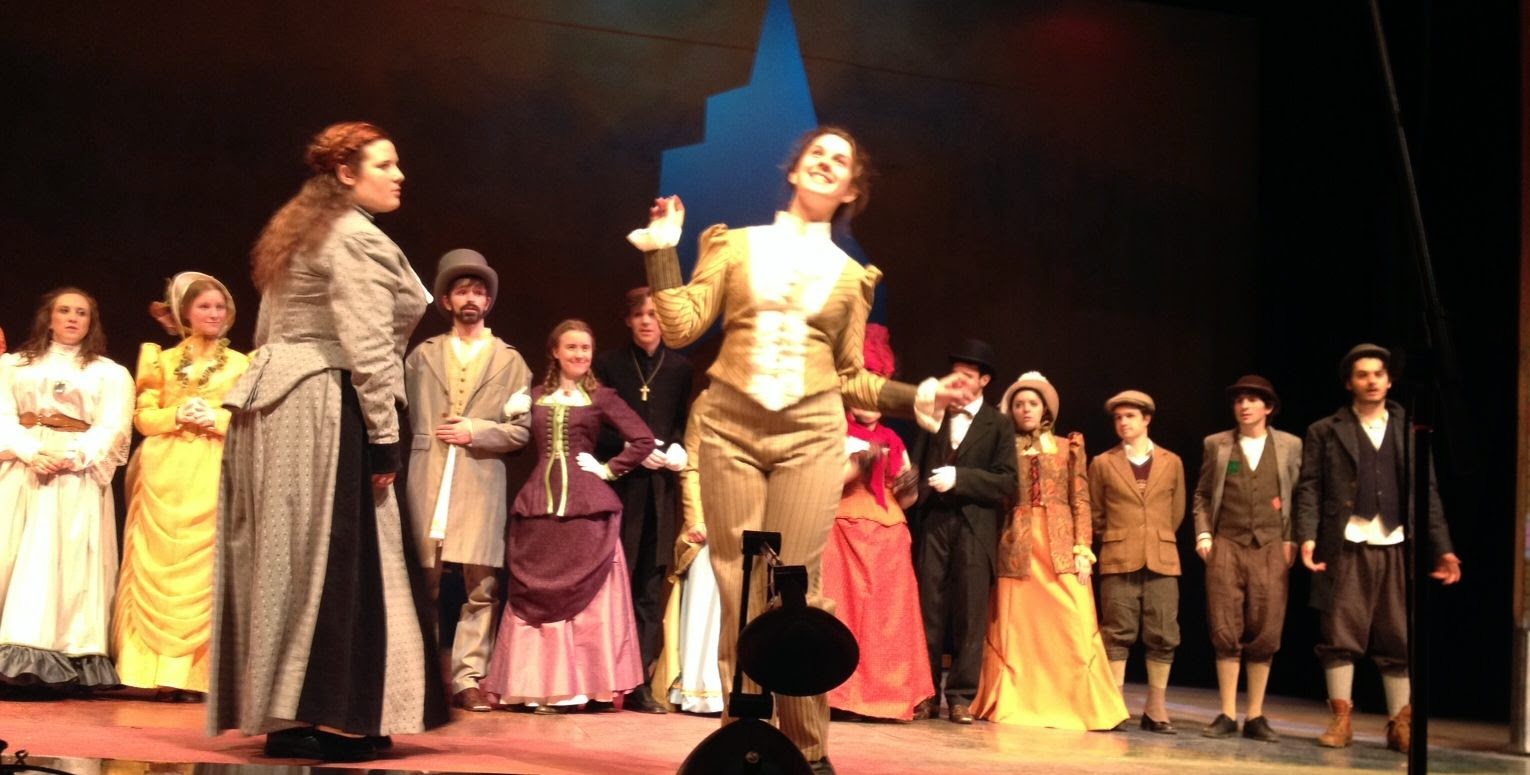
ALFRED:  Many think that Charles Dickens intended to murder Edwin Drood and make clear the “who” of whodunit but Dickens died before the final episode of the work was published. Who dispatched Drood? Authors and playwrights started proposing endings in 1870 but Rupert Holmes dusted off the mystery in 1985, set it to music and created the first Broadway musical with multiple endings (determined by audience vote).      Holme’s Drood garnered 5 Tony Awards including best musical.
            The Mystery of Edwin Drood will be yours to judge at the Miller Performing Arts Center at Alfred University on Thursday, Friday and Saturday, April 10 -12 at 8pm. Tickets ($10 adults, $5 students and retirees) must be ordered by April 10. Call 871-2828 or go to www.alfred.edu/performing_arts .
                The costumes, characters, accents, dances and toe-tapping songs are all good reasons for you to reserve tickets. Here are few of the people you’ll find in the cast.


                Dana Harris grew up in Los Angeles and is now a senior studying theater. She plays the part of stage manager.  This is Dana’s first musical since playing Lucy in Snoopy in high school. She said that Drood is stressful but exciting.  
                The day we talked Dana was still sparkling from being added to the lovers’ scene at the end. Her character speaks in a Scottish accent. Most of her colleagues have added a British lilt but Dana thought she’d mix it up a bit my rolling her words through Scotland.
                To prepare, she watched Brave several times and spent time studying David Tennent in Dr. Who. She listened to accents, practiced her lines with their tones and recorded herself for evaluation.
                Dana is impressed with the many excellent accents developed for Drood and she enjoys watching and listening to the character of Jasper but her favorite part of the musical is the role of Reverend Crisparkle. 


                The part of Durddles is played by Danny Gray (a sophomore in The School of Art and Design, from Madison, Wisconsin). When asked what makes Drood fun, Danny said, “Every line I speak is a blast for me.”
                Danny came to Alfred because of ceramics but he fell into theater and, lucky for all, loved it. On the stage he found friends and fun so he has acted again and again with Drood as his fourth show. Prior to AU, he’d only had a small part in Cabaret in high school.
                Danny said that he thinks all the tunes are fantastic but when pressed for a favorite he chose “Moonfall Quartet”.
                 “It’s moving and amazing, a serious touch in an otherwise silly show.”        


                One of the actors in “Moonfall Quartet” is Rosa Budd, played by Jessica Antrobus (a senior studying English and communications, from Cleveland). Jessica brings Rosa to life with friendship, fear, disgust, anger and more than a dollop of charm.
                She cited “Moonfall Quartet” as one of the highlights of Drood also. She said that the harmonies are beautiful and that kinship among the women fills the song with support as well as emotion.
                This is Jessica’s fifth experience on the stage at AU but she’s performed in many settings since she was 10, picking up skills and learning to get into a character along the way.
                Jessica clearly enjoys the dance sequence in “Off to The Races” where the entire cast makes the stage sparkle with “happy.” She said that she’s not a dancer but dances well enough to get the moves.


            Another character is portrayed by Darren Palmer who came to Alfred from Wingdale, NY. Darren is now a senior in theater after choosing his major as a junior. Drood is his fifth production.
            Each of those productions was directed by a different person so each brought different information, instruction and experiences to the growing actors. Darren said that this exposure helped him grow as himself as well as an actor developing characters.
            In Drood, Darren transforms into Bazzard, a hunched and lurching form, clutching his masterpiece and rendering his face into the physical definition of creepy. Sometimes he sheds Bazzard’s unnerving cloak to inhabit Philip Bax (Drood is a play within a play). As Bax, Darren sings “Never the
the Luck” with the support of several cast members. This, he says, as with all the times when the entire ensemble is on stage, is a warm experience of mutual support and community.               


                Darren encourages you to experience live entertainment whenever you can. He noted how a live experience is solidly different from a film or CD. He said that in movies each clip is likely seconds long. A live performance demands extended concentration from both actors and audience.
                Call for your tickets now and be in the moment with the entire cast of Drood at Alfred University on April 10-12 - Thursday, Friday or Saturday.