Wednesday, February 25, 2015

Upcycled at StoneFlowerPottery

Our first upcycled object was an old fire extinguisher. It became a lamp because we had neither money nor lamp. That was in 1974 and we’ve reused, reworked, rebuilt, redesigned, repurposed hundreds of objects since then. 
Generally, I enter the house at the back door where a seasonal decoration made of aluminum cans hangs on the door. This month it’s still the Valentines hearth.
Inside is a door we carried home from someone’s trash pile. The glass was broken but it’s the door to our basement so Rick put a wooden backing in and I made a tile sunflower to fill the space.


The old wooden ironing board next to the door was perfectly reworked to be our house gnome. Someone did a marvelous job creating her. 


We hang hats & jackets on a coat rack made from part of our upright piano and some vintage hooks. Above the rack is a mirror from discarded vanity. We took off the side wings to make it fit. On the wall opposite is what Rick calls my mess and I call my international bell and brush collection.


 I think of them as being upcycled because they were all meant for work, not for décor. There’s a scrub brush that I bought in China. Nobody ever meant to that to be admired. It’s not a work of art but of utility still, it’s no Brillo pad and so interested me. In my mind is an image of the. Another brush from China is a huge calligraphy brush. It’s likely that was meant to be admired and maybe treasured.
 We’ve a wooden Thai sheep bell and some wonderful mental donkey bells from Peru. They are all handcrafted and marvelous, at least to me.
 There’s a small typewriter cleaning brush. Are you old enough to remember typewriters? The keys would get clogged with dust and goo from the ribbons (remember ribbons?) and they needed to be cleaned to make the images sharp again. I wonder if clogged keys made tracing typewriters difficult for police or if that ever mattered.


Aluminum Can Flower Workshop

(Today is Feb 25 and we have one slot open for this workshop.)


Sunday, December 7, 2014

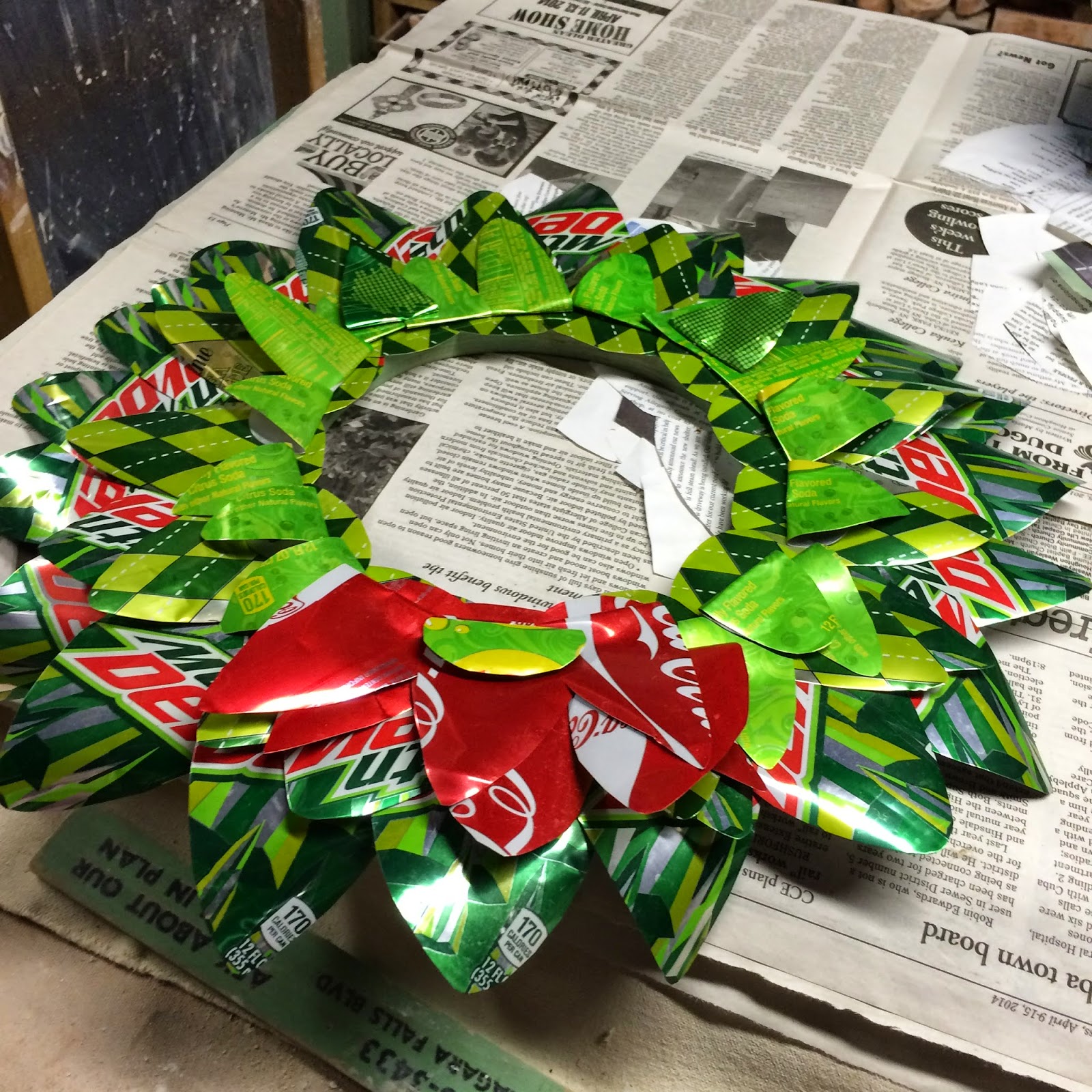
Soda Can Door Wreath


There’s normally a large, aluminum can flower on our side door but I thought we should switch to red and green for December’s many holidays.
     The backing is sign board. We purchase scraps from a local sign company.
     I traced one of my 14 inch bats (I’m a potter and that’s one of the things I use to throw on the wheel.) I found the center of the circle and traced a jar there. The outside of the circle is cut with the band saw. Easy peasy if one remembers to apply and release the tension bar which I did.
     Cutting out the center requires the use of the drill press and the scroll saw and multiple occasions of clamping, cutting, unclamping, moving, clamping, cutting. No, I did not cut into the workbench. 0
      Lucky for me, my husband is a cabinet maker so there are tools of all kinds including an oscillating sander to finish off the inside and outside edges.
      I painted the back and edges and drilled and used pop rivets to attach a hanger so after all that the stuff that doesn’t show was ready.
      This project required 28 standard 12 ounce cans - so that’s finding and cleaning and cutting apart 28 cans of appropriate color, then cutting the shapes after I fiddled with newspaper ideas to see where and how to hide the staples.
      The actual stapling was the fastest and most fun part. Now I want a white and red wreath for February and a pastel wreath for spring. Then we can use the big green flower all summer again.


Friday, November 21, 2014

Simple Gifts Part 2

WELLSVILLE: This series started because my mind is often on gifts and my hands are often making them or admiring things made by others. The goal is to encourage people to make gifts of objects or time during these overlapping family seasons.
Making things is a valuable use of time. A gift seems a double gift when given with the words, “I made this for you.”         
Have you made a gift for someone lately? If not, there is still time and here are other ideas to infuse holidays with simple gifts, simple times, social interactions.
Simple Gifts Series, Part 2 of 4
This proposal is about promises and coupons, kits and ideas.
          Our children always made coupons for us. Computer programs and websites make coupon design easy, or at the least possible. You might print your own holiday cards and send them to people with a coupon good for one dinner out together or for a New Year’s Eve hike in the woods with wine, cheese and a glorious sky.
            You might give a coupon for a lesson in making jelly, in canning tomatoes, in baking a pie with a fluffy crust, in wiring a lamp, in using a smart phone or in the fine art of drywall. Is there someone you could teach to knit or to even just to join for a day of baking things your mother baked?
          If coupons don't appeal to you, consider a kit. In searching the internet for kit gift ideas, it’s easy to be buried or at the least distracted, by the tens of thousands of ideas out there. Here are some websites that offer craft ideas
www.craftsolutions.com – nestled among hundreds of advertisements are ideas
www.craftster.org – general crafts, foods, some special projects that would be one of a kind items
www.busybeekidscrafts.com - simple kid projects with instructions
          This website has many craft instructions. Print the instructions and gather the materials into a box or plastic bag and there’s a gift to go.
http://craftbits.com has all kinds of instructions including a page of gifts-in-a-jar.
          If you aren’t interested in coupons or kits, make something with a friend.
          You might get a group of people together for a workshop at The Studio at the Corning Museum of Glass. Have you ever gone there? You can schedule a group party to make a project, pay the fee and go for the fun of it. One all-ages workshop involves making a picture frame. Another is about 
sandblasting designs on a glass. See cmog.org for more or call (800) 732-6845.


 (Here are some of the projects that one can make at The Studio, Corning Museum of Glass.)


          Did you know that Sarah Phillips is a marvelous teacher with a studio full of stuff and the grace and patience of a seraph? She has an open workshop on Mondays and Wednesdays from 10-3:30. Bring your lunch and ideas and pay $5 plus some additional fees if you choose to use some more expensive materials. Sarah can give you more information if you call her at (585) 437-5225.

       Having said all that, if there is snow, forget it all, grab a carrot nose and get to work on Frosty. Use your own lawn or go to a nursing home and work in view of their largest windows or find the home of a fragile person and work there. You’ll get an audience and sometimes a cup of coca afterwards. Call ahead first.
          If you want handmade and some connection without doing the making yourself, find marvelous craftspeople and artists at alleganyartisans.com. Many of us have hours by appointment. Shop slowly and hear the story behind the work to get inspired to work yourself or to buy handmade.

            There will also be a show at the Community Hall behind St. Philip's Church in Belmont on December 12 &13. There will be things hand stitched, hand formed, hand carved, hand drawn, hand strung, hand hammered, hand woven, hand built, hand thrown and otherwise carefully hand made. Find makers, their stories and some great cookies. Call (585) 808-0385 for information on this Friday/Saturday show. Maybe you can talk a one of the people there into giving private lessons.

Wednesday, November 5, 2014

Simple Gifts Series - Part 1

WELLSVILLE: My mind is on gifts for the many celebrations of the winter season. Of course it is. My days are spent designing and making things and hoping that what comes from my hands will make people smile and be used for decades.
          Because so much of my time is spent making things, I feel the value of objects made by hands. I hold them, turn them, look at the seams and the colors and appreciate the care that went into the creation of handmade work.
          My mind holds strongly to the goal that gifts will be handmade, not necessarily by me, but by a real person working with hands turned graceful and strong by experience. It seems a worthy goal to encourage more people to make things so with that goal in mind, here are some ideas to reclaim the holidays with simple gifts, simple times, social interactions.
Simple Gifts Series, Part 1 of 4
          These handmade plans were sparked by the Allegany Arts Association when the winter newsletter started marching from blank paper to printed issue at Dave’s Printing. I’d asked Editor, Joanne Allen, to feature an article offering a gift workshop. We’d have a workshop in November and try to steer people toward handmade.   
          The Allegany Arts Association* is a conduit for learning to craft an object as well as for appreciating what has been crafted from objects, sound and movement. Most of their programs are for children in the summer and in February but they are flexible in their programs so are sponsoring a pair of workshops for adults.
            On Wednesday, November 19 at 6 pm put your heart into a handmade gift. These workshops are open to adults ages 18+ and generously hosted by the Town of Wellsville at the old Wellsville Community Center building on Main Street in Wellsville.
            Choose to make a clay bowl with Elaine Hardman, StoneFlowerPottery. Please bring as many of these things as you can: a rolling pin, one section of newspaper, a paper grocery bag, a pencil, a pair of scissors, 6 absorbent paper towels.
          If you can’t bring everything, that’s okay. Hopefully there will be enough of these things to share. There is room for 15 people and at the time of this issue, 6 are registered.
            During the 2 hours, you will make a stoneware bowl, safe for food, the dishwasher and your microwave. Call 585-808-0385 to register, bring your payment with you and be sure to be around a week later to pick up your finished bowl.
            Or you may work with Betsy Orlando, well-known fiber artist, doll maker and paper artist, to make a mini Christmas album during this 2 ½ hour workshop.
            Betsy asks that you bring these things to use yourself and extras if you can to share: 3 or 4 empty toilet paper tubes, holiday paper such as scrapbook paper or heavy gift wrap and trims such as ribbon, beads, buttons and stickers. (NOTE: THIS CLASS IS FULL.) 
            For either project, you must pre-register and make a donation of $15 or more to the Allegany Arts Association. This will cover materials with the remainder going to support the Allegany Arts Association. Betsy and Elaine are volunteering their time.
          Another option is to go to Alfred Knitting Studio for Knitting Nights. This is an open invitation to sit and knit or ask someone for lessons from 6-8 pm at the Alfred Knitting Studio. They offer a warm knitting area, cookies, tea, friendship and conversation in any of Frank and Lynn Bunke’s cozy chairs.


*The Allegany Arts Association is NOT part of the Allegany Artisans or the Wellsville Art Association or the Wellsville Creative Arts Center. It has existed since 1980 to offer free art workshops to children and to encourage exposure to performing arts in Allegany County.


Monday, October 27, 2014

Charles Clough Arena Painting: Hamburg

HAMBURG: There are as many definitions for art as there are shapes to form. For some it’s about interpreting society while others focus on color and texture. It might be a tool to define place or a means of recording history. For Buffalo’s Albright-Knox Art Gallery this past weekend it was about 48 gallons of paint mixed, stirred, splashed and enjoyed by friends at the latest landscape project with artist Charles Clough and his “big fingers.”
                A few months ago the Albright-Knox put out a call for volunteers willing to employ puddles of paint under the guidance of Clough using his trademark abstract method. It would be, they said, performance and interaction on a work destined to be installed in the Hamburg Library.
                Potters like me are familiar with “messy” but clay messes are gray and dusty while paint makes a mess with colors. The project accepted me so garbed in mucky shoes, ruined jeans and a splattered sweat shirt, we rambled our way to Hilbert College on Saturday morning.
                There wasn’t much guidance from Aaron Ott, Curator of Public Art for the museum. He said not to wear precious clothing and to arrive at 11. The unbendable rule was to keep paint the carpet.
                Hilbert College offered the Swan Auditorium stage as a painting venue, though some might see that as an act of enormous faith in strangers. The majority of the stage was covered in plastic and duct tape while “Messy Shoe Police” guarding the stairs. 
                The Shoe Police assiduously checked feet as people aged 2 through 90 s they flung, dripped, poured, splashed splattered and dumped cups of latex paint over a 6 by 17 foot canvas with various levels of accuracy. The canvas was surrounded by a drip pan that looked inadequate to the task of containing 48 gallons.
                Each participant was allotted 3 plastic cups of color from the rainbow array chosen by Clough and each color danced with pride on the canvass for brief moments before another splat arrived.
                Little ones poured and smeared. Tidy folk approached with a plan and then bumped into wildly messy painters who flung with abandon. Others timidly dripped.
                Each participant chose an area, played the paint game and recorded their efforts by pressing a cardboard over their area and pulling it away with a gooey mono print that the Albright Knox would mail to them later.
                As the hours passed, cameras took still shots, time lapse and videos because the project includes a film and book. Periodically Clough came out to make mono prints that he would add to later and then present as gifts to the Erie County Library System to display as they wished with the primary canvass going for permanent installation at the Hamburg Library.
                Clough interacted with many talking about their areas of work and posing for photos, particularly with family groups who came to get messy together.

                In a sense this project started in 1985 when Clough was invited to paint a 20 x 60 foot wall at the Brooklyn Museum. He’d been finger painting small pieces and having them photographed and printed in larger formats but there were 2 problems. Large photos at the time were expensive and disappointing.
                “What I needed,” said Clough, “were bigger fingers.”
                So, he made big fingers. Wooden circles and ovals were affixed to long poles and covered with padding and leather. Some were used as single units and others were banded together in a series of 4 fingers.
                When people told him that their ___________ (fill in the space) could paint like that, he decided to let people in, show them the process and let them try. People, he thought, didn’t often enough experience art as uncertainty, choice and community.
                At this project, one enthusiastic painter was 9 year old Maggie Ggiehart. Maggie worked carefully with greens and black and pulled an intricate swirl of color on her mono print. She said that her dad gave her an easel and canvas to work on at home. Her dad said they might buy a tarp to protect the floor since Maggie was vibrating with enthusiasm after her experience.
                While Maggie and 199 others had their hands in the work, the finished canvas will likely not show her touch. At 5 pm, Clough was set to take on the remainder of the paints with some big fingers and make the surface his own. The other 200 participants will be present in the resulting book and film as well as their personal mono prints.

                The Albright Knox Art Gallery is on Elmwood Avenue in Buffalo and offers tours, classes, exhibits, lectures, yoga, community outreach and hundreds of definitions of art. 

Friday, October 10, 2014

Missing the Gentle Hands of Bruce Greene

Bruce’s Hands

ALFRED STATION: The leaves are gold and red among pumpkins turning orange but inside some hearts the world is blue. As Allegany Artisans dust off their signs and clean their studios, many will pause to think of two long time members, Charley Orlando and Bruce Green, who will not be adding their warmth and welcome to the 27th Annual Studio Tour on October 18 & 19.
                Much has been written about both of these generous men. Both were treasured in their families. Both were teachers whose voices wove permanently into the lives of hundreds of students. Both created objects now found comfortably within thousands of homes across the country, working into family traditions as well as everyday life. Both helped to build their communities with a generosity that is less and less common.
                Susan Greene spent some time with me in the home that she and Bruce filled with memories and history as she described to me the hero of her life, her husband, Bruce Greene.
                Bruce Robert Green was born in 1939 and worked pretty much ceaselessly until September this year.  FDuring
During 40 of those years his were the hands that created Hillbottom Pottery in Alfred Station.
                For 24 years he guided Alfred Almond’s high school students as they gained critical thinking proficiency, planning skills, social behaviors, self expression methods and the myriad lessons of math and science needed to employ various mediums of art in their coursework.
                Susan said that she and Bruce were in concert in their beliefs and attitudes. Both felt that much of the work they did was an act of worship. Bruce valued creating things with his hands and worked with gratitude and respect.  This generous, gentle man and his wife found objects created by long-gone hands and brought them into their home to honor the lines, the designs, the craftsmanship, the color, the utility and the labor of their involved.
                “These look like things but they’re not. These are memories. They represent a place we saw or they stand for a conversation Bruce and I shared.” Susan said while showing the collection that she and Bruce gathered over decades.
                How does she most remember Bruce?  As many others, Susan remembers her husband as a teacher. Teaching was important to him. Students were important people and they knew it. It’s why so many came to celebrate his life at the memorial service at the Alfred Station Seventh Day Baptist Church. It’s why several of them created a “Teacher Quilt” to warm him in his last days at the Hart Comfort House.
                It’s why his voice still guides them in their lives and careers. Though their careers are not art-centered, they are always Mr. Greene-assisted. One past student became a ceramic engineer who feels that Mr. Greene put art into his personal and high tech life. Another said that art is communication and so is useful in all fields.
                Bruce and Susan both saw making art as a vulnerable act. She worked with elementary students giving them background information and confidence to move toward creative works. When they met Bruce in junior and senior high school, they felt secure in making creative leaps. Art was part of life for students of all grade levels at Alfred Almond Central.
                As a teacher, he was a gentle man but he had expectations and presented structure with lots of room for exploration. His interactions with students gave them room to find happiness and made them aware of their environment.
                As a potter he was pragmatic. He spoke, at times,of his love/hate thing with clay. He’d get tired of a design or a process but he always pressed forward because of the pride he knew with the making of  attractive, appealing, appreciated objects. 
                He felt that he was given the role to bring beautiful, satisfying things into people’s lives. He didn’t want a lot of “ballyhoo” about it but he enjoyed that sense that so many potters have of being written into someone’s life by virtue of the favorite mug or the morning cereal bowl.
                In this way, Bruce Greene continues in many lives. A mug handle connects him with a person, a place, a time and his memory is honored by this.
                Bruce felt that there is good and God in handmade things. Artisans know that there is beauty in a piece of wood, a silver wire, a ball of clay or an old can and as they pass that material through their hands they bring out this beauty. This creative act, the Greenes know, connects with the idea of creative people having been themselves created.
                During his last months, Bruce’s brain was under assault and his body suffered from it but he pushed himself to do things so that there would be greater room in Susan’s life to finish the book she published in January. She didn’t know how hard the struggle was for him until the spring because he didn’t complain. He just helped. This she sees as heroic and typical. He was always ready to help anyone.   
                His studio still holds his clay tools and some of his last pots. The Allegany Artisans have agreed to an exception in their policy to allow Susan Green to sell this pottery during the hours of the 2014 Studio Tour on October 18 & 19, from 10 am to 5 pm.       
                There will be 39 other studios open and hosted by 46 members of the Allegany Artisans ready to show what their hands have created. You may want to establish a connection in your life with something handmade and humbly presented.
                Call the Allegany County Office of Tourism at 1-800-836-1869 or write to AlleganyArtisans@gmail.com to request a brochure listing all participants.
               

Wearable Prints, 1760-1860, History, Materials, and Mechanics was published by Susan W. Greene in January, 2014.  It is available on Amazon.


When I suffered a hip injury years ago, Bruce Green taught me to throw standing up. Bruce stacked things on the floor to stand on and made measurements and sketches. Thus armed, Rick Hardman did a bit of welding and carpentry to change a foot operated wheel into a hand operated model. The modified machine has what Bruce called a “belly bar”. His invention makes it possible to lean into the clay with steady pressure easing the stress on back and hip.